 Record Impact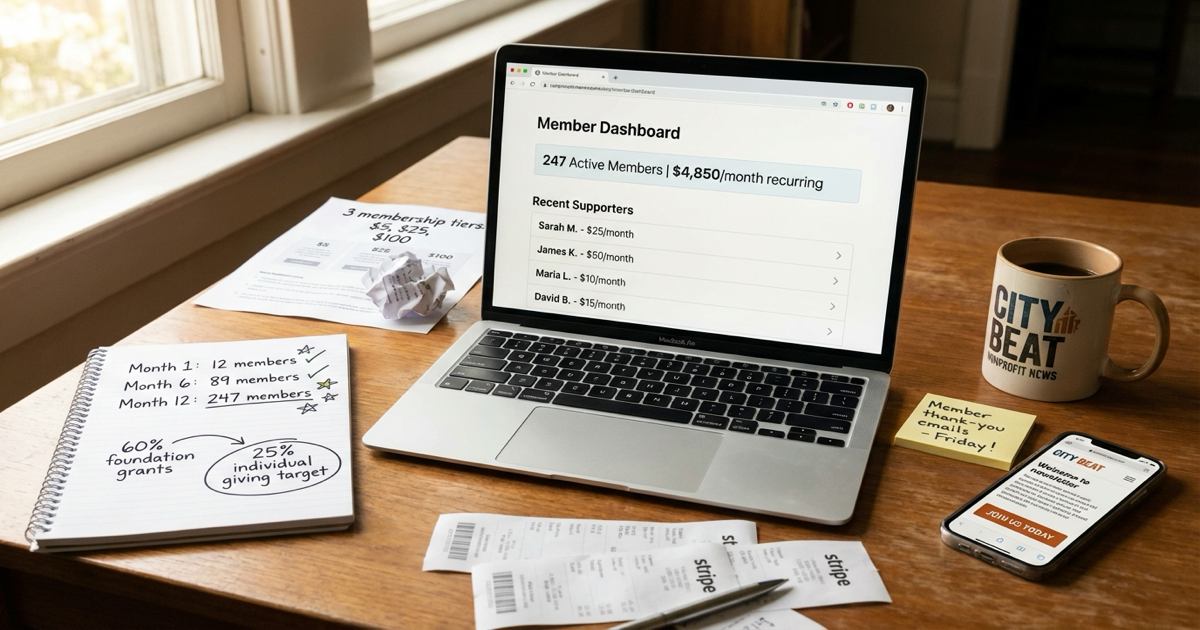
Why Membership Matters
With 60% of non-profit newsrooms deriving over half their budget from foundation grants, the math is simple: when foundations shift priorities or tighten belts, your newsroom is vulnerable. Membership programs create a direct link between journalism quality and organizational financial health, transforming passive readers into active financial supporters.
The News Revenue Hub recommends that healthy newsrooms generate at least 25% of total revenue from memberships and individual giving. That’s not just diversification—it’s insurance against existential risk.
The Foundation Dependence Problem
Here’s the uncomfortable truth: foundation grants are:
- Competitive: 86% of nonprofit news outlets are competing for the same limited pool of foundation dollars
- Unpredictable: Priorities shift, program officers change, strategic focuses evolve
- Restricted: Many grants come with specific use requirements that limit operational flexibility
- Time-consuming: Grant applications and reporting consume scarce staff capacity
Membership revenue, by contrast, is flexible, renewable, and scales with audience growth. It’s also a signal funders look for—demonstrating community support strengthens your case for foundation funding.
Start Small, Start Now
Most successful membership programs began modestly. You don’t need sophisticated technology or a dedicated staff member to launch. Here’s the practical path:
Phase 1: The Foundation (Week 1-4)
Set up basic infrastructure:
- Payment processor (Stripe or similar) - 2 hours
- Donation page with recurring option - 4 hours
- Email confirmation workflow - 2 hours
Choose your membership levels:
Simple is better. Three tiers work well:
- Supporter: $5-10/month - Most accessible entry point
- Sustainer: $25-50/month - Sweet spot for most members
- Champion: $100+/month - For your most committed readers
What you offer at each level matters less than you think. Most people give because they value your journalism, not because they want tote bags. Save yourself the fulfillment hassle.
Make the ask:
- Add a membership call-to-action to your newsletter (takes 15 minutes)
- Include it at the end of high-performing stories
- Put it in your email signature
That’s it. Week one, you can be live.
Phase 2: Build the Habit (Month 2-6)
Establish monthly outreach rhythm:
Every month, dedicate 3-4 hours to membership cultivation:
- Monday: Email existing members with journalism highlights from the past month
- Wednesday: Feature a member story in your newsletter (with permission)
- Friday: Social media push highlighting specific impact from your reporting
Track what works:
You don’t need fancy analytics. A simple spreadsheet tracking:
- Source of sign-ups (newsletter, article page, social, etc.)
- Monthly retention rate
- Response to different messaging
Optimize your ask:
The most effective membership appeals:
- Are specific: “Help us keep covering city hall” beats “support quality journalism”
- Include urgency: “We’re $5,000 short of our goal to hire a data reporter”
- Show impact: “Member support funded the investigation that changed the zoning ordinance”
Phase 3: Scale and Sustain (Month 6+)
Upgrade your approach when you have momentum:
Once you’re bringing in $2,000-5,000/month in membership revenue, consider:
Dedicated campaigns:
- End-of-year giving push (can double monthly revenue)
- Matching gift opportunities (double donor impact, drive urgency)
- Specific project funding (“Help us cover the election” or “Support our housing crisis series”)
Member experience:
- Monthly member-only newsletter or Q&A with reporters
- Annual member event (virtual or in-person)
- Early access to major investigations
Retention focus:
Acquiring new members is 5-7x more expensive than retaining existing ones. Monthly member emails are not optional—they’re insurance against churn.
The Numbers That Matter
Realistic expectations for year one:
- 50-200 active members (depending on audience size)
- $500-3,000/month in recurring revenue
- 70-80% monthly retention rate (20-30% annual churn is normal)
What “good” looks like at scale:
- 1% of monthly unique visitors become members (ambitious but achievable)
- $30-50 average monthly contribution
- 80%+ retention rate
- 25-35% of total budget from membership/individual giving
Common Pitfalls (And How to Avoid Them)
Mistake #1: Overcomplicating the offering
You don’t need branded merch, special events, or exclusive content to launch. Add those later if they make sense. Start with the ask itself.
Mistake #2: Only asking during crises
“We might shut down without your support” works once. Build membership into your regular operations, not emergency fundraising.
Mistake #3: Ignoring existing members
Send monthly updates. Celebrate their support. Show impact. Retention is everything.
Mistake #4: Treating membership as a side project
Even at a 4-person newsroom, someone needs to own this. 5-10 hours per month minimum. If that’s genuinely impossible, you’re not ready to launch—focus on creating capacity first.
Mistake #5: No measurement
If you’re not tracking sources, retention, and campaign performance, you’re flying blind. Use spreadsheets if you must, but track something.
When to Invest More
Hire a part-time development person or expand membership focus when:
- Monthly membership revenue exceeds $5,000
- You have at least 200 active recurring donors
- Churn rate is under 25% annually
- You’ve validated that increased effort drives increased revenue
Before that point, keep it lean and focused.
The Timeline Reality Check
Month 1: You’re sending asks and getting trickles of support. This feels slow. That’s normal.
Month 3: You’ve figured out which messages work and have 20-50 members. Revenue barely moves the budget needle.
Month 6: You’re at 75-150 members, bringing in $1,500-3,500/month. This now matters to your bottom line.
Month 12: 150-300 members, $3,000-7,000/month, and you’ve secured 10-20% budget diversification.
Year 2-3: Compound growth. Retention improves. Your base grows. You hit 25%+ of budget from individual giving.
This is a long game. But it’s a game you need to play.
Integration with Grant Fundraising
Smart Development Directors don’t see membership and grants as competing priorities—they’re complementary:
Membership strengthens grant applications:
- Demonstrates community support and engagement
- Provides unrestricted operating funds
- Shows diversified, sustainable revenue model
- Proves audience values your work
Foundation funds can seed membership programs:
- Some funders explicitly support capacity building for individual giving programs
- Knight Foundation, Democracy Fund, and others have funded membership launches
Pitch them together. Track them separately.
Tools You Actually Need
Minimum viable stack:
- Payment processor (Stripe: 2.9% + $0.30 per transaction)
- Email platform you already use (likely Mailchimp, Constant Contact, or similar)
- Spreadsheet for tracking
Nice to have:
- Donor management CRM (when you hit 200+ members)
- Membership platform (News Revenue Hub, Memberful, etc.)
- Thank-you automation workflows
Don’t let tool selection delay your launch. Start simple, upgrade when it hurts not to.
Resources and Support
News Revenue Hub: Free resources, coaching, and tools specifically for non-profit news membership programs. They’ve helped dozens of newsrooms do this successfully.
INN: Institute for Nonprofit News offers workshops, peer learning, and best practices documentation.
Your peers: Other newsrooms have figured this out. Ask them what worked. The INN listserv is gold for this.
Take Action This Week
If you’re serious about building membership revenue:
Monday: Set up a Stripe account and basic donation page (2 hours)
Tuesday: Draft three versions of your membership ask with different framings (1 hour)
Wednesday: Add the strongest version to your newsletter template (30 minutes)
Thursday: Email your board and closest supporters with the new membership option (1 hour)
Friday: Track who signed up and what messaging they responded to (30 minutes)
Total time investment: 5 hours. Total cost: $0 upfront.
You’ll know within 2-3 weeks if you have traction. If you do, keep going. If you don’t, adjust messaging and try again.
Membership programs don’t save newsrooms by themselves. But they might help you keep the lights on long enough to do the journalism that does.