 Record Impact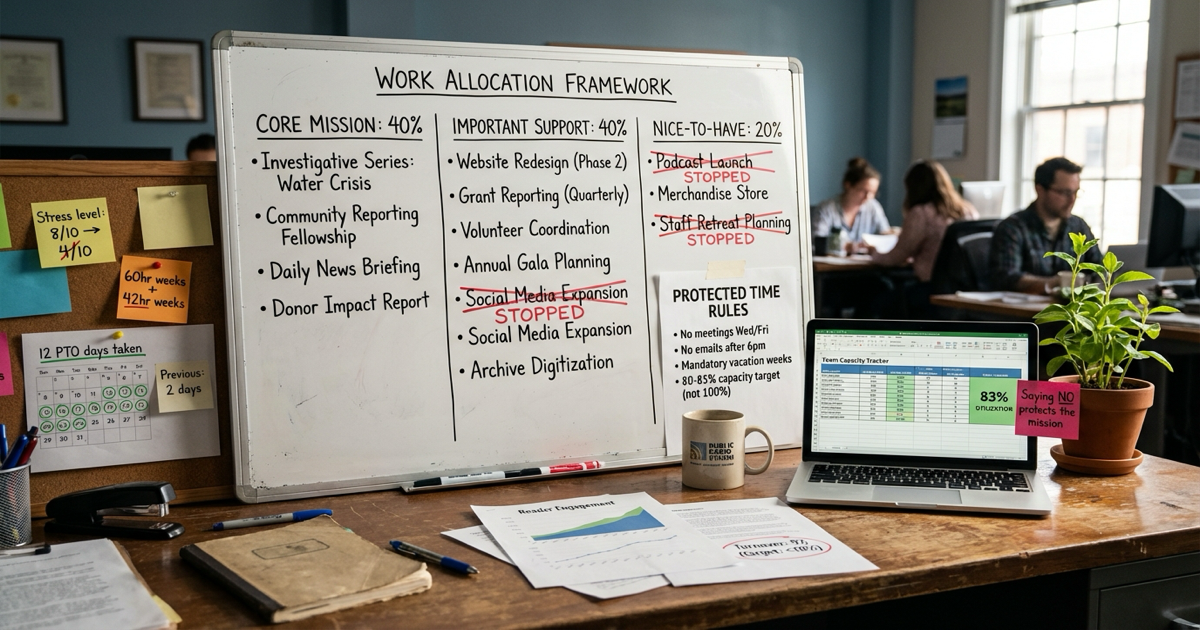
Preventing Staff Burnout in Mission-Driven Newsrooms
The Burnout Crisis
The formula for nonprofit news burnout is simple math:
Heavy workloads (4-person team doing 8-person team’s work)
- Mission pressure (“democracy depends on what we do”)
- Non-competitive compensation (could earn 30-50% more elsewhere)
- Resource scarcity (“we can’t afford to hire help”) = High turnover risk that threatens everything you’ve built
When staff burn out and leave, you lose institutional knowledge, funder relationships, editorial continuity, and community trust. The remaining team absorbs more work, accelerating their burnout. The cycle repeats.
Most nonprofit newsroom leaders know this. The question isn’t whether burnout is a problem—it’s what you can do about it when you genuinely can’t afford more staff and the mission genuinely does require intense effort.
This isn’t about meditation apps or wellness seminars. This is about structural changes that make the work sustainable without requiring more money you don’t have.
Understanding the Problem: It’s Not Just Overwork
Burnout in mission-driven organizations has unique characteristics:
Mission-driven burnout looks like:
- Staff who can’t disconnect because they feel personally responsible for outcomes
- People working unsustainable hours because “the community needs this story”
- Guilt about taking time off when colleagues are overwhelmed
- Identity fusion where personal worth is tied to work output
- Inability to say no because everything feels mission-critical
Traditional overwork looks like:
- Clear boundaries between work and life
- Expectation that it’s temporary (deadline, project launch, busy season)
- Compensation that acknowledges extra effort
- Defined scope that doesn’t constantly expand
The solution isn’t asking staff to care less. It’s creating systems that protect their capacity to continue caring.
Warning Signs: Early Detection Matters
Individual warning signs:
- Consistent work beyond scheduled hours (not occasional deadline pushes, but pattern)
- Difficulty disconnecting (checking email at 10pm, working weekends regularly)
- Quality decline (more errors, missed deadlines, shorter tempers)
- Cynicism or detachment (eye-rolling at meetings, resigned comments about “nothing changing”)
- Physical symptoms (persistent fatigue, illness, headaches, sleep problems)
- Loss of enthusiasm for work that previously energized them
Organizational warning signs:
- Staff turnover rate >15% annually
- Exit interviews citing workload, stress, or burnout
- Internal conflicts increasing (tension between staff who were previously collaborative)
- Vacation days going unused (or staff working during PTO)
- “Hero culture” where working extreme hours is praised
- Projects consistently late or incomplete
- Difficulty filling open positions (reputation for burnout spreads)
Red flag pattern: When your highest performers start showing signs, act immediately. They often hide burnout best until they suddenly quit.
The Structural Solutions
1. Ruthless Prioritization (Not Everything is Mission-Critical)
The problem: Everything feels mission-critical, so nothing gets cut.
The solution: Forced ranking with clear criteria.
How to implement:
Each quarter, list all active projects and ongoing work. Force-rank them in three tiers:
Tier 1: Core Mission (40% of capacity)
- Journalism that directly serves your unique mission
- Work only you can do in your market
- Examples: investigative series, beat coverage, community engagement
Tier 2: Important Support (40% of capacity)
- Grant reporting (non-negotiable)
- Fundraising (sustains mission)
- Operational necessities
- Strategic communications
Tier 3: Nice-to-Have (20% of capacity)
- Experimental projects
- Optional events
- Side initiatives
- Professional development
Key rule: If work doesn’t fit in these allocations, it doesn’t happen. No exceptions. No guilt.
Practical application:
When someone suggests a new project or initiative, ask:
- What tier is this?
- What current work would we stop or reduce to create capacity?
- Is this more mission-critical than what we’d sacrifice?
Most of the time, the answer is no. That’s okay.
2. Protected Time: Make Breaks Non-Negotiable
The problem: Staff technically have PTO but feel unable to use it, or work during time off.
The solution: Structural policies that remove individual guilt.
Policies that work:
Mandatory PTO blocks:
- All staff take the last week of December off (office closed)
- All staff take one full week off each summer (staggered)
- No work email/Slack access during PTO (IT-enforced if necessary)
Coverage rotation:
- Explicit coverage assignments when someone is out
- No expectation of “checking in” while away
- Post-vacation review to catch anything truly urgent
Workload adjustment:
- Week before vacation: reduce assignments to allow cleanup
- Week after vacation: reduced meeting load to allow catch-up
- No major deadlines the week someone returns from PTO
Sick time culture:
- Sick means sick (not “working from home while sick”)
- Leadership models this (ED who works through illness sets bad precedent)
- No expectation of being “available” when out sick
3. Sustainable Work Hours: Define and Defend
The problem: Undefined expectations lead to scope creep and guilt about leaving “on time.”
The solution: Explicit norms with leadership modeling.
Set clear expectations:
For full-time staff:
- Standard hours: 40 hours/week
- Core collaboration hours: 10am-3pm Monday-Thursday (everyone available)
- Flex time: Remaining hours can be scheduled flexibly
- After-hours: Only for genuine emergencies (defined explicitly)
What counts as emergency:
- Breaking news directly in your coverage area
- Time-sensitive public records before deadline
- Source only available outside business hours (and scheduled in advance)
What doesn’t count as emergency:
- Routine emails after 6pm
- Weekend grant report work
- Non-urgent story edits
Enforcement:
Leadership actively intervenes when staff overwork:
- “I see you’re emailing at 9pm. Take tomorrow afternoon off to compensate.”
- “You worked last Saturday. You’re blocked from this Wednesday’s meetings—take the day.”
- “Your vacation was interrupted by work. Add two days to your next PTO.”
Make overwork uncomfortable, not praised.
4. Decision Authority: Reduce Bottlenecks
The problem: Everything requires executive approval, creating delays and overloading leadership.
The solution: Distributed decision authority with clear boundaries.
Define decision levels:
Staff can decide without approval:
- Story angles within beat coverage
- Source outreach and interview scheduling
- Social media posting (within editorial guidelines)
- Routine operational tasks
- Spending under $100 on approved budget categories
Staff can decide with notification:
- New story ideas outside regular beat
- Speaking engagements or external appearances
- Partner organization collaborations
- Spending $100-500 on approved categories
Requires leadership approval:
- Investigations requiring significant time investment
- Legal risk stories
- Budget changes or spending >$500
- Hiring, firing, major policy changes
Why this reduces burnout: Staff aren’t waiting for bottleneck approvals. Leadership isn’t overwhelmed with decisions that don’t need them. Work flows.
5. Meeting Discipline: Protect Deep Work Time
The problem: Constant meetings fragment days, pushing substantive work to evenings/weekends.
The solution: Radical meeting reduction with clear rules.
New meeting standards:
Meeting-free days:
- No meetings Wednesdays and Fridays (deep work days)
- Only urgent/breaking news meetings interrupt this
Meeting constraints:
- No meetings before 10am or after 4pm
- All meetings have agenda distributed 24 hours ahead
- Default meeting length: 30 minutes (extend only if justified)
- Standing meetings audited quarterly (still needed? eliminate if not)
Meeting efficiency:
- Start/end on time (no grace period for latecomers)
- Decisions recorded and circulated immediately after
- Maximum 5 people (larger meetings are updates, not working sessions)
Async-first culture:
- Default to written updates over meetings
- Use collaborative docs for feedback cycles
- Reserve meetings for true collaboration or decision-making
Result: Staff have 2-3 hour uninterrupted blocks for deep work on mission-critical journalism.
6. Growth Without Breaking: Scaling Strategically
The problem: Success creates demand that exceeds capacity, tempting you to push staff harder instead of growing sustainably.
The solution: Explicit capacity tracking with growth rules.
Track capacity honestly:
Quarterly assessment:
- What % of staff capacity is utilized? (Target: 80-85%, not 100%)
- How many hours of overtime occurred? (Target: <5% of total hours)
- How many projects were delayed due to capacity constraints?
- Staff stress self-assessment (1-10 scale, anonymous)
Growth rules:
Before adding new work commitments:
- Do we have 15-20% spare capacity to absorb this?
- If not, what existing work will we stop?
- Can we fund additional staff to own this?
Hiring triggers:
Add staff when:
- Existing team consistently at >90% capacity for 3+ months
- Overtime regularly exceeds 5% of total hours
- Quality metrics declining (errors, missed deadlines)
- Anonymous stress assessments consistently high (>7 on 10-point scale)
Don’t add staff when:
- Work can be cut/deprioritized instead
- It’s temporary surge (cover with contractors or delayed launch)
- You can’t afford sustained salary (better to decline work than hire then fire)
The Leadership Mindset Shifts
From: “We all need to sacrifice for the mission” To: “The mission requires sustainable capacity, not burnt-out staff”
From: “Taking time off means we’re not committed” To: “Taking time off protects our ability to continue the work”
From: “More work shows dedication” To: “Effective prioritization shows leadership”
From: “We’ll rest when funding is secure” To: “Sustainable work practices improve our funding success”
From: “Burnout is an individual problem” To: “Burnout is an organizational design flaw”
What Doesn’t Work (Stop Wasting Money on This)
Wellness programs without workload reduction:
- Free gym memberships
- Meditation apps
- Yoga classes
- Mental health days
These are fine as benefits. They don’t prevent burnout if the work itself is unsustainable.
Heroic culture:
- Praising extreme hours
- “First one in, last one out” as badge of honor
- Competitive overwork (“I only slept 4 hours”)
This actively encourages burnout and creates toxic peer pressure.
Ignoring compensation:
If you’re paying 30% below market and expecting passion to compensate, you’re extracting value from mission-driven people. Either pay competitively or accept higher turnover.
The Honest Compensation Reality
You probably can’t pay market rates. That’s the reality for most nonprofit newsrooms. But there are ways to partially compensate:
What helps when salary is limited:
- Exceptional flexibility (work from anywhere, flexible hours)
- Generous PTO (25-30 days vs. 15-20 standard)
- Professional development budgets (training, conferences)
- Clear, realistic workload expectations
- Transparent growth path and timeline to higher compensation
- Retirement contributions (even small ones)
- Public recognition and celebration of work
What makes low compensation unbearable:
- Unrealistic workload on top of low pay
- Lack of flexibility
- No path to improvement
- Feeling taken advantage of
If you can’t pay more right now, at least ensure the work itself is sustainable and the trajectory is clear.
Measuring Progress: What to Track
Quarterly metrics:
- Average hours worked per week (including overtime)
- Vacation days taken vs. accrued
- Staff stress self-assessment (anonymous, 1-10 scale)
- Project completion rate vs. projections
- Quality metrics (error rates, deadline adherence)
Annual metrics:
- Turnover rate (target: <10% voluntary turnover)
- Exit interview themes
- Staff retention of high performers (>2 years tenure)
- Sick days used (both too high and too low are warning signs)
Red flag thresholds:
Act immediately if:
- Average work week exceeds 45 hours for >2 consecutive months
- More than 20% of vacation days go unused
- Stress assessments average >7 on 10-point scale
- Voluntary turnover exceeds 15% annually
- Multiple staff leave citing same issues
The Realistic Timeline
Month 1-3: Implement meeting discipline and protected time policies. Minimal cost, immediate stress relief.
Month 3-6: Ruthless prioritization of projects. Cut 20% of work that’s lowest-value. Redistribute capacity.
Month 6-12: Assess whether workload is sustainable or whether growth is needed. Plan hiring or further cuts.
Year 2: Evaluate compensation improvements. Even 5-10% raises make a difference if paired with sustainable workload.
This doesn’t fix everything overnight. But it stops the bleeding and creates foundation for sustainable growth.
Take Action This Week
Monday (30 minutes): List all active projects and ongoing work. Force-rank them in three tiers: Core Mission, Important Support, Nice-to-Have.
Tuesday (1 hour): Audit last month’s staff hours. How many people regularly exceeded 40 hours? How many took PTO? Document patterns.
Wednesday (1 hour): Draft protected time policy: no-meeting days, PTO expectations, after-hours norms. Circulate to staff for feedback.
Thursday (30 minutes): Review upcoming 6 months. What committed work will exceed capacity? What needs to be cut or delayed?
Friday (1 hour): Meet with staff individually. Ask: “On a scale of 1-10, how sustainable does your workload feel? What one change would make the biggest difference?”
Total time investment: 4 hours. You’ll identify the highest-leverage changes specific to your team.
Burnout won’t fix itself. And you can’t hire your way out if you lack resources. But you can create organizational structures that make the work sustainable—which protects your mission better than burning through talented staff.