 Record Impact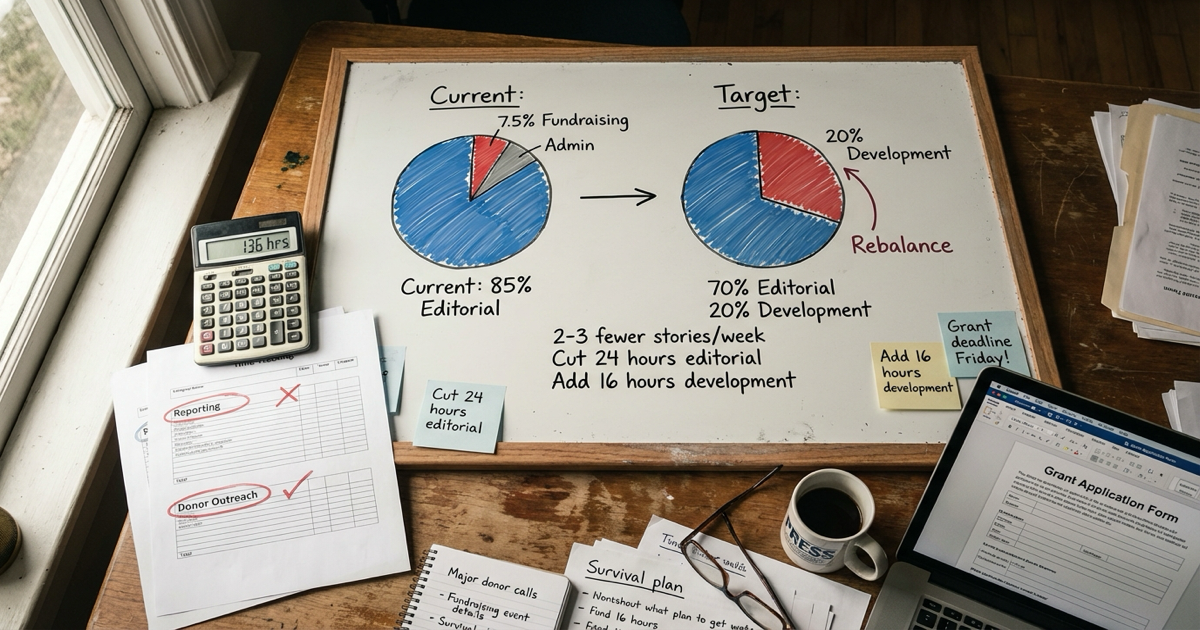
Time Allocation Strategies for Lean Newsrooms
The Capacity Gap
The numbers tell a brutal story:
- 85% of staff time goes to editorial work
- 33% of newsrooms spend less than 10% of capacity on business functions
- 54% cite business/marketing/fundraising as their greatest staffing need
Here’s what that looks like at a typical 4-person newsroom:
Current allocation:
- Editorial/reporting: 3.4 FTE (85%)
- Development/fundraising: 0.3 FTE (7.5%)
- Operations/admin: 0.2 FTE (5%)
- Marketing/audience: 0.1 FTE (2.5%)
What they actually need:
- Editorial: 2.5-3 FTE
- Development: 0.8-1 FTE
- Operations: 0.3-0.4 FTE
- Marketing/audience: 0.3-0.4 FTE
The gap is structural. You’re not doing something wrong—you’re trying to run a business with insufficient resources allocated to the business functions that keep it alive.
Strategic time allocation doesn’t eliminate this gap. But it can shift how you use scarce capacity to break the vicious cycle instead of reinforcing it.
The Vicious Cycle You’re Trapped In
Current state:
- Most time goes to editorial (mission delivery)
- Minimal time for development/fundraising (resource generation)
- Insufficient fundraising results in resource scarcity
- Resource scarcity prevents hiring business-side staff
- More editorial work falls to existing team
- Even less time available for development
- Cycle reinforces itself
The trap: You can’t afford to invest in business capacity, but without business capacity, you can’t generate the resources to invest in anything.
Breaking the cycle requires: Temporarily reallocating time away from editorial to business functions that generate resources—even though it feels counterintuitive and mission-compromising.
The Strategic Reallocation Framework
Step 1: Audit Current Time Allocation (Week 1)
Track actual time usage for 2-4 weeks. Don’t rely on guesses.
Categories to track:
Editorial Production:
- Reporting/interviewing
- Writing/editing
- Research and investigation
- Editorial meetings
Audience Development:
- Social media
- Newsletter
- Community engagement
- Event planning
Fundraising/Development:
- Grant writing
- Grant reporting
- Donor cultivation
- Membership program work
Operations:
- Bookkeeping/finances
- HR/payroll
- IT/tech support
- Legal/compliance
Administration:
- Internal meetings
- Email/communication
- Planning/strategy
- Professional development
Tool: Simple time-tracking spreadsheet. Each person logs hours daily by category. Takes 5 minutes per day.
What you’ll learn: Where time is actually going vs. where you think it’s going. Usually there’s a 20-30% gap.
Step 2: Calculate ROI per Hour (Week 2)
Not all activities generate equal value. Rank by return on investment.
High ROI activities (generate resources or mission impact):
- Grant applications (potential: $25,000-100,000 per 40 hours invested)
- Major donor cultivation (potential: $5,000-50,000 per 20 hours invested)
- Investigative journalism that drives impact (mission fulfillment + funder appeal)
- Membership program operations (recurring revenue, compounds over time)
Medium ROI activities (necessary but don’t directly generate value):
- Grant reporting (required for compliance, protects existing funding)
- Routine beat coverage (mission delivery, audience maintenance)
- Newsletter and social media (audience retention, some donor cultivation)
- Financial management (prevents disasters, doesn’t generate resources)
Low ROI activities (busywork or nice-to-have):
- Internal meetings without clear decisions
- Social media beyond strategic posts
- Attending events that don’t generate leads or coverage
- Perfecting work beyond “good enough”
Brutal honesty required: Some journalism is high-ROI (investigations that change policy, coverage that drives funding). Some is low-ROI (routine stories that don’t move the needle on mission or funding).
Step 3: Target Reallocation (Week 3)
Shift 10-15% of capacity from low-ROI to high-ROI activities.
Example reallocation for 4-person team (160 hours/week):
Current allocation:
- Editorial: 136 hours (85%)
- Development: 12 hours (7.5%)
- Operations: 8 hours (5%)
- Audience: 4 hours (2.5%)
Target reallocation:
- Editorial: 112 hours (70%) - reduce by 24 hours
- Development: 28 hours (17.5%) - increase by 16 hours
- Operations: 12 hours (7.5%) - increase by 4 hours
- Audience: 8 hours (5%) - increase by 4 hours
Where to cut 24 editorial hours:
- Reduce story count by 2-3 pieces per week (focus on quality over quantity)
- Eliminate lowest-impact beat coverage
- Cut meeting time by 50% (see meeting discipline in burnout article)
- Reduce story length for routine coverage (600 words vs. 1200)
Where to invest 16 development hours:
- 8 hours: Grant applications and research
- 4 hours: Major donor cultivation (calls, coffee meetings, personal outreach)
- 2 hours: Membership program operations and optimization
- 2 hours: Grant reporting (spread throughout month, not crisis-mode)
Where to invest 4 operations hours:
- 2 hours: Financial planning and scenario modeling
- 1 hour: Impact tracking and data management
- 1 hour: Strategic planning and decision-making
Where to invest 4 audience hours:
- 2 hours: Newsletter optimization for member conversion
- 1 hour: Social strategy focused on donor cultivation
- 1 hour: Community engagement that drives membership
Step 4: Test and Measure (Month 2-3)
Run the reallocation for 2-3 months. Track outcomes.
Metrics to watch:
Revenue metrics:
- Grant applications submitted (target: 2x previous rate)
- Grant $ awarded
- New major donors (>$1,000)
- Membership growth rate
- Total development time ROI ($ raised per hour invested)
Editorial metrics:
- Stories published (will decrease—that’s expected)
- Story quality/impact (subjective, but track major wins)
- Audience engagement (pageviews, newsletter opens, shares)
Risk metrics:
- Funder satisfaction (any complaints about coverage reduction?)
- Staff morale (is reduced editorial output demoralizing?)
- Audience retention (are people leaving because of less content?)
What success looks like after 90 days:
- $50,000-150,000 in new grants applied for
- 3-5 new major donor relationships in pipeline
- Membership revenue up 10-20%
- Editorial quality maintained despite lower volume
- No significant audience drop or funder complaints
If it’s working: Continue and consider further reallocation.
If it’s not working: Diagnose why—wrong activities, insufficient time shift, or structural barriers?
Specific Time Allocation Strategies
Strategy 1: The 70/20/10 Split
For 4-person team:
- 70% Editorial (112 hours): Core mission work, best journalism you can do
- 20% Development (32 hours): Revenue generation, funder relationships
- 10% Operations (16 hours): Financial planning, impact tracking, strategic decisions
Rationale: You need at least 20% on development to break the cycle. Less than that and you’re not moving the needle on funding. More than 30% and you risk mission drift.
Strategy 2: The Dedicated Development Day
Implementation:
- One day per week is “Development Wednesday” (or whatever day works)
- No editorial work scheduled that day
- All development activities concentrated: grant writing, donor calls, membership work, impact tracking
For a 4-person team:
- Executive Director: Full day on major donor cultivation and grant strategy (8 hours)
- One other staff member: Half day on grant research or membership operations (4 hours)
- Total: 12 hours per week = 15% of capacity
Pros: Creates focus and reduces context-switching Cons: Editorial deadlines may conflict with fixed development day
Strategy 3: Seasonal Reallocation
Recognition: Development needs fluctuate with grant cycles.
Grant season (usually Q4 and Q1):
- Shift to 60% editorial / 30% development / 10% operations
- Reduce story output, focus on applications
Off-season (Q2 and Q3):
- 75% editorial / 15% development / 10% operations
- Catch up on journalism, maintain funder relationships
Annual average: ~70% editorial / 20% development / 10% operations
Pros: Aligns with natural grant rhythms Cons: Requires planning and clear communication with audience/funders about seasonal variation
Strategy 4: Role Specialization (When You Hit 5+ Staff)
Once you reach 5+ people, specialize:
One person dedicated to development (0.5-1 FTE minimum):
- Grant writing and reporting
- Donor cultivation
- Membership program
- Impact tracking
Everyone else focuses on editorial (with minimal development tasks):
- Reporters focus on reporting
- ED focuses on strategy and major donor relationships
- Minimal context-switching improves productivity
Critical mass: This only works if you can afford a dedicated development person (often requires securing capacity-building grant first—see case study article).
Common Time Allocation Mistakes
Mistake #1: “We’ll focus on development once we’re stable”
Reality: You’ll never be stable until you focus on development. Waiting for stability is waiting forever.
Fix: Accept temporary editorial capacity reduction to invest in revenue generation.
Mistake #2: Spreading development work too thin
Reality: 2 hours per week per person on fundraising generates almost nothing. It’s not enough to build relationships or write quality proposals.
Fix: Concentrate development time—full days, not scattered hours.
Mistake #3: Treating all editorial work as equally valuable
Reality: Some journalism is high-impact (investigations, accountability reporting). Some is low-impact (routine updates, reactive coverage).
Fix: Cut low-impact editorial to protect high-impact work and create development capacity.
Mistake #4: No time for strategic planning
Reality: 100% of time on execution means you’re always reactive.
Fix: Protect 5-10% of capacity for strategic planning, financial modeling, and decision-making.
Mistake #5: Leadership doing everything
Reality: ED writing grants, doing bookkeeping, managing social media, editing stories, and cultivating donors is unsustainable.
Fix: Delegate or eliminate lower-value work. ED should focus on highest-ROI activities (major donor relationships, strategic fundraising).
When to Shift Back to Editorial
Increase editorial allocation when:
- Development pipeline is strong (6-12 months funding visibility)
- Membership revenue is growing predictably
- Grant reporting is current and manageable
- You’ve built sufficient reserves (3+ months runway)
Don’t shift back when:
- Single grant success creates temporary comfort
- You haven’t addressed underlying funding diversification
- Development infrastructure is still fragile (no systems, single person doing everything)
Warning: Most newsrooms shift back to editorial too soon. Sustainable funding requires sustained development focus, not occasional sprints.
Special Case: Tiny Teams (1-3 People)
If you’re a 1-3 person operation:
Time allocation is even more critical. You can’t do everything.
Minimum viable allocation:
- Editorial: 60-65% (just enough to maintain mission delivery)
- Development: 25-30% (non-negotiable for survival)
- Operations: 10% (bare minimum financial management)
What this means you can’t do:
- Daily publication schedule (shift to weekly or 2-3x per week)
- Comprehensive beat coverage (focus on 1-2 priority areas)
- Social media presence beyond basics (automate or abandon)
- Attendance at every relevant event (selective engagement only)
Brutal truth: At 1-3 people, you’re choosing what NOT to do. Choose wisely.
Quarterly Time Allocation Review
Every quarter, spend 2 hours reviewing:
- Time tracking data: Where did capacity actually go?
- ROI analysis: Which activities generated results (funding, impact)?
- Missed opportunities: What high-value work didn’t happen due to lack of time?
- Reallocation decision: Should we shift time allocation for next quarter?
Questions to answer:
- Are we investing enough in development to break the funding cycle?
- Is our editorial work high-impact or just high-volume?
- What low-value work can we eliminate?
- Do we have time for strategic planning, or only execution?
- Is current allocation sustainable, or are we burning out?
Take Action This Week
Monday (1 hour): Set up time tracking system. Brief team on categories and tracking process.
Tuesday-Friday: Everyone tracks time daily (5 minutes per day).
Next Monday (1 hour): Review first week of time data. Identify gaps between intended and actual allocation.
Next Friday (2 hours): Team meeting to discuss reallocation targets. What editorial work can we cut? Where should we invest freed capacity?
Week 3: Implement reallocation plan for 90-day test.
Month 4: Review results and decide whether to continue, adjust, or revert.
Total upfront time investment: 4-5 hours. Potential payoff: Breaking the vicious cycle that’s keeping you under-resourced.
The Hard Truth
Strategic time allocation won’t save your newsroom by itself. But spending 85% of capacity on editorial while neglecting the business functions that sustain the organization is a path to slow-motion failure.
Reallocating 10-15% of capacity from editorial to development feels like mission compromise. It’s not. It’s mission protection.
The journalism you’re not doing this year because you’re investing in fundraising is journalism you’ll be able to do for the next 5 years because you’ve secured sustainable funding.
Trade short-term editorial output for long-term organizational survival. That’s the strategy.