 Record Impact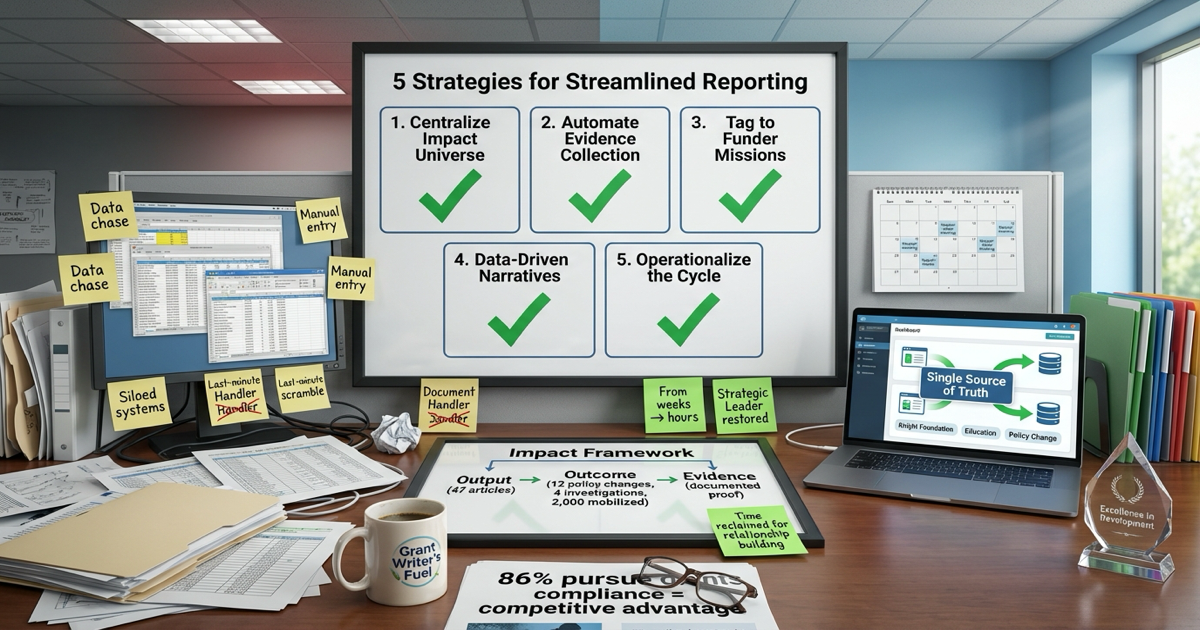
Mastering Stakeholder Reporting & Grant Compliance for Nonprofit News
Grant reports aren’t just compliance documents—they’re the most powerful tool for building trust with funders and securing future funding. Yet for many nonprofit journalism leaders, the grant reporting cycle presents a frustrating contradiction. This comprehensive guide will show you how to transform reporting from an administrative burden into a strategic fundraising engine.
Table of Contents
- The Effectiveness Paradox: Why Reporting Feels Like Drowning
- Understanding Different Funder Requirements
- The 5 Strategies for Streamlined Reporting
- Grant Compliance Essentials
- Creating Compelling Annual Impact Reports
- Common Mistakes to Avoid
- Frequently Asked Questions
The Effectiveness Paradox: Why Reporting Feels Like Drowning
For many leaders in non-profit journalism, the grant reporting cycle presents a frustrating contradiction. Foundations, in their quest for strategic and accountable grantmaking, have instituted reporting requirements that, paradoxically, drain their grantees of the very time and energy needed to achieve their mission. This phenomenon—the “effectiveness paradox”—leaves Development and Executive Directors feeling as though they are drowning in paperwork, distracted from purpose.
The role of a strategic leader devolves into that of a “document-handler,” managing endless revisions and deadlines by hand, a process that is not only inefficient but fraught with the potential for inaccuracies and delays.
The Root of the Challenge
The root of this challenge lies in the widespread reliance on ineffective manual approaches. Critical impact data is often siloed in disparate systems—scattered across individual spreadsheets, email chains, and disconnected documents—making organization-level management nearly impossible. This fragmentation inevitably leads to:
- Poor records management that makes compliance difficult
- Inconsistent reporting across different grants and funders
- Constant anxiety about deadlines and missing data
- Misallocated time away from strategic fundraising work
The administrative burden of applying for grants and managing them detracts from the primary strategic function of a development leader: building new funder relationships and securing the resources necessary for the organization to thrive.
The Strategic Stakes
This is not merely an operational inefficiency; it is a critical strategic liability. The time consumed by manually compiling reports is precisely the time that is needed to cultivate the diverse revenue streams essential for long-term financial sustainability and to move away from an over-reliance on a handful of foundations.
In a fiercely competitive funding landscape where 86% of nonprofits pursue foundation grants but few receive an impactful amount, this misallocation of a leader’s time can become an existential threat. Non-compliance can lead to fund clawbacks, poor reporting damages reputation and future opportunities, and quality reports directly impact funding renewal rates.
A Fundamental Shift in Perspective
This guide proposes a fundamental shift in perspective. A grant report should not be viewed as a retrospective compliance document or a mere summary of expenses. It is, in fact, the single most powerful tool for building trust with funders and securing future funding.
The objective must be to transform the reporting process from a burdensome administrative cost center into a high-ROI fundraising engine. The following five strategies provide a clear, actionable roadmap to streamline the entire reporting process. The ultimate goal is not just to file reports faster, but to win back the most valuable asset—time—and reinvest it in the strategic work of fundraising, relationship building, and ensuring the long-term health of the organization.
Learn more: Breaking free from the effectiveness paradox →
Understanding Different Funder Requirements
Funders are not a monolith; they are mission-driven organizations with highly specific strategic priorities, thematic interests, and geographic focuses. Understanding what each type of funder values and requires is essential to meeting their expectations and securing continued support.
The Funder Paradox
There’s an inherent tension in foundation grantmaking: foundations seek to simplify applications and reduce burden on grantees, yet they require rigorous proof of performance and impact. Organizations find themselves caught between the demand for simplicity and the need for substantive, data-rich reporting that demonstrates accountability and results.
Major Foundation Requirements
Different foundations have distinct reporting philosophies and requirements:
Knight Foundation
- Focus: Specific metrics on reach and impact in journalism innovation
- Requirements: Detailed audience engagement data, evidence of community impact, innovation metrics
- Reporting Style: Data-driven with emphasis on scalability and replication
MacArthur Foundation
- Focus: Mission alignment and long-term outcome documentation
- Requirements: Narrative reports emphasizing strategic alignment, theory of change, qualitative and quantitative outcomes
- Reporting Style: Strategic and reflective, with emphasis on learning and adaptation
Federal Grants
- Focus: Strict compliance with legal agreements
- Requirements: Detailed financial tracking, time allocation records, rigorous documentation standards
- Reporting Style: Highly structured with binding compliance terms and audit trails
Media-Specific Funders
For journalism organizations, media-specific funders have unique expectations:
- Evidence of dissemination: Tracking media mentions, social media reach, and republication across platforms
- Proof of influence: Demonstrating how journalism penetrates public discourse and reaches intended audiences
- Impact beyond metrics: Moving from pageviews to policy changes, community mobilization, and real-world outcomes
The Generic Report Trap
One of the most common and damaging mistakes in grant reporting is submitting a generic, one-size-fits-all document. A report that fails to speak directly to a funder’s unique mission—whether it’s supporting reporting on climate change, promoting civic engagement, or protecting press freedom—will fail to demonstrate value and resonate with its intended audience. It signals a lack of attention and can damage the trust that is crucial for a long-term funding relationship.
Guide: Navigating major funder requirements →
The 5 Strategies for Streamlined Reporting
Strategy 1: Centralize Your Impact Universe—From Scattered Spreadsheets to a Single Source of Truth
The most significant bottleneck in grant reporting is the chaos of fragmentation. In many non-profit newsrooms, critical information exists in siloed systems. Financial data lives in one department’s software, programmatic outcomes are tracked in spreadsheets on a program manager’s laptop, powerful testimonials are buried in email threads, and media mentions are noted sporadically, if at all.
The Fragmentation Problem
This disorganization is the primary driver of poor records management, a state that makes complying with funder requirements and even internal governance incredibly difficult. The development team is forced into a constant, time-consuming cycle of requesting data from the program team, who must continually track and enter program data, creating a collaboration that is essential but often inefficient.
The Solution: A Single Source of Truth
The solution is to establish a centralized, dynamic, and living repository for every piece of evidence related to the organization’s impact. This is a strategic move away from static, error-prone spreadsheets toward a unified impact database that becomes the definitive hub for all grant-related information, from financial expenditures to qualitative outcomes.
Such a system must be designed to capture the full spectrum of a newsroom’s influence:
- Media mentions and reach: Tracking social media, online publications, and broadcast channels
- Financial expenditures: Linking spending directly to specific grants and projects
- Programmatic outcomes: Community testimonials, policy changes, individual actions
- Qualitative evidence: Stories, quotes, and contextual narrative that brings data to life
Focus on Media Tracking
For a journalism organization, evidence of dissemination across social media, online publications, and broadcast channels is not a vanity metric; it is direct proof of influence. Funders, especially those in the media space, need to see that the journalism they support is penetrating the public discourse and reaching its intended audience.
A central database allows for the effortless collection, categorization, and searching of these mentions, creating a direct, traceable link from a specific story back to the grant that funded it. This provides tangible, reportable proof of the work’s reach and engagement.
From Reactive to Proactive
The establishment of a centralized impact universe fundamentally transforms an organization’s posture from reactive to proactive. Instead of scrambling to find information when a report is due, the Development Director can respond to requirements almost instantly.
This system is more than an archive; it becomes a queryable, strategic asset. The ability to ask the database specific questions—“Show me all impact related to our climate change reporting in the last six months,” or “Generate a list of all policy-makers who have cited our work”—is a game-changer.
It allows the organization to seize unexpected opportunities, such as a short-deadline grant announcement or a sudden meeting with a potential new funder, by generating a tailored, evidence-backed summary of impact on demand. The data ceases to be a static record of the past and becomes a dynamic tool for securing the future.
Strategy 2: Automate Your Evidence Collection—Capture Impact in Real-Time, Not at the Deadline
The manual collection of data is a profound drain on a Development Director’s time and a major source of organizational friction. The process of chasing down metrics, reminding reporters to submit anecdotes, and manually entering data from various sources is incredibly time-consuming and labor-intensive.
The Data-Chasing Problem
This constant “data-chasing” forces development staff into the role of administrators rather than strategists, and the repetitive cycle leaves little time for the crucial work of data analysis and strategic decision-making. This last-minute scramble to gather information before a deadline is not only stressful but also a recipe for incomplete data, inaccuracies, and team-wide burnout.
The Solution: Real-Time, Automated Capture
The most effective strategy to overcome this bottleneck is to make impact collection an effortless, integrated part of the daily workflow, rather than a separate, dreaded task. The goal is to automate the capture of evidence so that impact is logged as it happens, when the details are fresh and the context is clear.
This can be achieved through a variety of low-friction methods:
Mobile-Friendly Forms
- Simple data entry forms that reporters can complete in less than one minute
- Proven effective by tools like the IA Impact Tracker
- Accessible on any device, anywhere reporters are working
Communication Platform Integrations
- Dedicated Slack channels where staff can quickly share links, notes, and community feedback
- Systematic parsing and addition to the central database
- Already in use at innovative newsrooms like Charlottesville Tomorrow
CRM and Email Integration
- Automatic capture of key data points from existing systems
- No manual intervention required
- Seamless flow of data from multiple sources into the central repository
The Benefits of Real-Time Capture
By automating the collection process, an organization ensures a continuous and consistent flow of high-quality data. Capturing impact in real-time dramatically improves the accuracy and richness of the information, as details are not lost to memory over a three-month reporting period.
This approach effectively ends the end-of-quarter crisis mode. It frees the Development Director from the drudgery of data collection and empowers them to focus on the higher-value work of analyzing the impact and crafting compelling narratives for funders.
Building a Culture of Impact
This shift from manual, periodic collection to automated, continuous capture does more than just save time; it fundamentally instills a “culture of impact” throughout the organization.
In a traditional newsroom, a journalist’s work might be considered “done” when an article is published. By integrating a simple, automated, and required step of logging the real-world effect of that article, the definition of “done” evolves. The work is not truly complete until its impact is recorded.
This small process change aligns every member of the team—from reporters and editors to management—around the ultimate metric of success: demonstrable, real-world change. It turns every employee into an active participant in the fundraising process, encouraging them to think in terms of outcomes, not just outputs. In this way, the automated system becomes the mechanism that embeds a focus on impact into the organization’s very DNA, making fundraising a shared responsibility rather than a burden borne solely by the development office.
Strategy 3: Speak the Funder’s Language—Tag Every Outcome to Their Core Mission
As established earlier, submitting generic reports is a critical mistake. The solution is to build a robust and strategic tagging system within the centralized impact database. This goes far beyond simple categorization.
Multi-Dimensional Tagging
Every single piece of evidence—every article published, every media mention logged, every community testimonial collected, every policy change influenced—must be meticulously tagged with multiple, intersecting data points.
Key tags should include:
- Funder & Grant: Directly link each outcome to the specific grant or grants that supported the work
- Thematic Area: Categorize the impact by subject matter using terms that align with funder priorities, such as “Social Justice,” “Public Health,” “Education,” or “Government Accountability”
- Impact Type: Define the nature of the change that occurred, using categories like “Policy Change,” “Community Mobilization,” “Individual Action,” “Legal Outcome,” or “Shift in Public Discourse”
- Geographic Focus: Note the specific community, city, or region that was affected by the work
The Power of Hyper-Personalized Reporting
This multi-dimensional tagging system transforms the database into a powerful reporting engine. With a few clicks, a Development Director can filter and generate a report that is perfectly and precisely tailored to any given funder.
Instead of a generic summary, the report can state with verifiable accuracy: “Here is a complete, documented list of the 17 distinct outcomes—including two pieces of local legislation introduced and over 500 residents mobilized for a town hall—that your $50,000 grant for ‘environmental reporting in the Midwest’ produced this year.”
This level of hyper-personalized reporting is incredibly powerful. It demonstrates:
- Exceptional stewardship of funds
- A sophisticated understanding of the funder’s goals
- A shared commitment to achieving a specific mission
From Retrospective to Predictive
While the primary benefit of tagging is creating better backward-looking reports, its true strategic power lies in its predictive capabilities.
By analyzing the tagged data in aggregate, the impact database is transformed from a simple record-keeping tool into a source of predictive intelligence for future fundraising. A Development Director can now analyze the patterns within the tags to answer critical, forward-looking strategic questions:
- “Which of our reporting themes are generating the most frequent and powerful types of impact?”
- “Is there a specific type of outcome, like community action, that our work is particularly effective at catalyzing?”
- “Which funders’ stated interests most closely align with the areas where we have a proven track record of success?”
This analysis provides a data-driven foundation for the next round of grant applications, shifting the organization’s fundraising strategy from an opportunistic “what can we get funding for?” to a confident “what are we verifiably excellent at, and who will fund that excellence?”
The reporting data, once a historical chore, becomes a predictive model for future growth.
Strategy 4: Weave a Data-Driven Narrative—Proving Real-World Change Beyond the Pageview
For too long, non-profit newsrooms have relied on “output” metrics—the number of articles published, website pageviews, or social media followers. While easy to measure, this data presented without context is just noise; it fails to communicate the true value and impact of the work.
The Shift from Outputs to Outcomes
Funders are increasingly sophisticated, moving beyond simple metrics to demand evidence of tangible, real-world “outcomes”. They want to know not just what was produced, but so what? How did the journalism change a community, a policy, or a life?
Table: The Evolution of Impact Metrics in Journalism
| Outdated Output Metrics (The “What”) | Powerful Outcome Metrics (The “So What?“) | How to Prove It (Your Evidence) |
|---|---|---|
| Pageviews / Unique Visitors | A community is better informed, leading to action | Pre/post surveys, quotes from community members, increased attendance at civic meetings |
| Number of Articles Published | A specific policy, law, or corporate practice is changed | Legislative records, official company statements, interviews with policymakers citing your reporting |
| Social Media Likes / Shares | An official investigation is launched or a wrong is righted | Public records from government agencies, court filings, statements from law enforcement or oversight bodies |
| Number of Media Mentions | An individual’s life or perspective is tangibly changed | Direct quotes, testimonials, and stories from affected individuals collected via surveys or interviews |
| Awards Won | Public discourse around a key issue is demonstrably shifted | Analysis of other media coverage, op-eds, and public statements that reference your work as a catalyst |
Blending Quantitative and Qualitative Evidence
The most effective way to answer the “so what?” question is to weave a blended narrative that combines the “what” (quantitative data) with the “why” and “how” (qualitative evidence).
A powerful report uses the hard data from a centralized, trusted system as its foundation, and then brings that data to life with compelling stories, stakeholder quotes, and vivid testimonials. It is about demonstrating the human impact behind the numbers, making the connection between the organization’s work and its real-world consequences both clear and memorable.
The Difference Between Informing and Persuading
A standard report is designed merely to inform and meet compliance requirements. A data-driven narrative, however, is designed to persuade.
Funders are individuals who must justify their funding decisions to their own boards and stakeholders. While they require the quantitative data for their records, their enthusiasm, advocacy, and decisions about future investment are fueled by compelling evidence of change.
Stories “make the human connections and impact…more real and vivid” and “bring your data to life and engage stakeholders on an emotional level.” Therefore, mastering the art of the data-driven narrative is not an optional add-on; it is a direct lever on revenue.
It is the difference between a program officer checking a box that says “report received” and that same program officer forwarding the report to their director with the note, “This is exactly why we fund this organization. Let’s discuss increasing our support in the next cycle.”
Strategy 5: Operationalize Your Reporting Cycle—Make It a System, Not a Scramble
For too many non-profit newsrooms, grant reporting is not a process; it is a series of recurring, high-stress emergencies. Each reporting deadline triggers a new scramble, treating the report as a standalone “project” that disrupts normal operations, creates immense anxiety, and pulls key leaders away from strategic work.
The Chaos of Reactive Reporting
This reactive, chaotic approach is unsustainable and prevents the organization from scaling its fundraising efforts effectively. When reporting is treated as an event rather than a system, it creates:
- Unpredictable workload spikes that disrupt other strategic work
- Last-minute errors due to rushed compilation
- Missed deadlines that damage funder relationships
- Staff burnout from repeated crisis mode
The Solution: A Well-Oiled System
The final and most crucial strategy is to transform reporting from a chaotic event into a smooth, predictable, and continuous system. This involves operationalizing the entire grant cycle to build a well-oiled machine that runs quietly and efficiently in the background.
The key components of this system include:
1. A Shared Grant Management Calendar
- This is the foundational tool for moving from a reactive to a proactive stance
- A centralized, accessible calendar that tracks every application deadline, report due date, and renewal period
- Essential for managing workflows and ensuring nothing falls through the cracks
2. Clearly Defined Roles & Responsibilities
- A system only works when everyone understands their part
- Program staff and reporters: responsible for real-time impact capture using the automated tools
- Development Director: responsible for analysis, narrative crafting, and final submission
- This clear division of labor makes the collaboration between development and program teams seamless and effective
3. Standardized Templates
- Creating pre-approved, standardized templates for different types of reports saves an immense amount of time
- Ensures a consistent level of quality and professionalism in all funder communications
- Allows the team to focus on the content of the report rather than its format
4. Regular Impact Reviews
- Waiting for a deadline to review impact data is a critical error
- Hold regular, perhaps quarterly, meetings dedicated to reviewing the impact data being collected
- This practice, inspired by newsrooms like Open Campus which compiles quarterly impact briefs, allows the team to spot emerging trends, identify powerful stories early, and begin drafting narratives well in advance of any deadline
Making Reporting Predictable and Scalable
Building an operationalized system makes the reporting process predictable, scalable, and low-stress. It dramatically reduces errors, eliminates last-minute panic, and creates a stable foundation that can support a growing portfolio of grants without a corresponding explosion in administrative chaos.
Creating a Strategic Feedback Loop
This operational approach yields a benefit that extends far beyond efficiency. When reporting is a chaotic, last-minute event, the data gathered is used once for the report and then effectively archived. It serves a single, tactical purpose.
However, when reporting is an operationalized system with regular review cycles, that same data becomes a source of continuous organizational learning. This system creates a powerful strategic feedback loop:
- The editorial team can analyze the data to see which types of reporting are generating the most tangible impact and adjust their coverage priorities accordingly
- The leadership team can see which funders’ interests are most aligned with their proven successes and tailor future proposals with data-backed confidence
- The organization as a whole learns, adapts, and becomes more effective at achieving its mission, using its own impact data as a guide
The reporting system, once a retrospective chore, becomes a prospective tool for driving mission effectiveness.
Deep dive: The 5 strategies in detail →
Grant Compliance Essentials
In a fiercely competitive funding landscape where 86% of nonprofits pursue foundation grants but few receive impactful amounts, compliance isn’t optional—it’s a competitive advantage.
Understanding Grant Compliance
Grant compliance means adhering to all the terms, conditions, and requirements outlined in the grant agreement. This includes:
- Financial requirements: Proper tracking, allocation, and reporting of grant funds
- Programmatic requirements: Delivering the activities and outcomes promised in the proposal
- Reporting requirements: Meeting all interim and final reporting deadlines with complete, accurate information
- Legal requirements: Complying with any regulatory or statutory obligations
The Stakes of Non-Compliance
Non-compliance can have serious consequences:
- Fund clawbacks: Funders can demand the return of all or part of the grant
- Reputation damage: Poor compliance damages relationships and makes future funding unlikely
- Legal issues: Federal grants in particular carry legal obligations that can result in penalties
- Missed opportunities: Time spent managing compliance issues is time not spent on mission work or new funding
Key Elements of Grant Compliance
Financial Tracking and Time Allocation
Accurate payroll and time allocation is crucial for nonprofit grant reporting. Many grants require demonstration that staff time was spent specifically on grant-funded activities. This requires:
- Time tracking systems that capture staff hours by project and grant
- Financial systems that can allocate expenses to specific grants
- Documentation of how funds were spent according to approved budgets
- Audit trails that can withstand scrutiny from funders or auditors
Outcome Documentation
Modern funders want to see results, not just receipts. Outcome documentation requires:
- Baseline data captured before the grant period begins
- Progress monitoring throughout the grant period
- Final outcomes measured against stated goals
- Qualitative and quantitative evidence of impact
Deadline Management
Missing a reporting deadline is one of the most common compliance failures. Effective deadline management includes:
- Centralized calendar with all reporting deadlines
- Early warning system that alerts staff weeks in advance
- Regular check-ins to ensure data collection is on track
- Buffer time built into internal deadlines to account for unexpected delays
Understanding Legal Agreement Terms
Federal grants and some large foundation grants are binding legal agreements with specific compliance terms. Key areas to understand:
- Allowable and unallowable expenses: What grant funds can and cannot be used for
- Matching requirements: If the grant requires organizational match
- Audit requirements: Whether the grant will be subject to external audit
- Intellectual property: Who owns content or tools developed with grant funds
Checklist: Grant compliance requirements →
Creating Compelling Annual Impact Reports
A well-executed annual stakeholder report serves multiple audiences: foundations, individual donors, members, boards, and community. It is both a compliance document and a marketing tool—a way to demonstrate accountability while also inspiring continued and expanded support.
The Purpose of Annual Reports
Annual impact reports serve several strategic functions:
- Accountability: Demonstrating to stakeholders how resources were used
- Transparency: Building trust through honest, clear communication
- Marketing: Showcasing success to inspire future support
- Reflection: Creating space for organizational learning and strategic planning
- Relationship building: Deepening connections with funders and supporters
Best Practices for Annual Impact Reports
Lead with Outcomes, Not Outputs
Don’t just list activities—demonstrate real-world change:
❌ Weak: “We published 47 investigative articles this year” ✅ Strong: “Our 47 investigative articles led to 12 policy changes, 4 official investigations, and mobilized over 2,000 community members to civic action”
Use Specific Examples and Testimonials
Bring the data to life with stories from real people:
- Include direct quotes from community members whose lives were changed
- Share testimonials from policymakers who cited your work
- Highlight specific instances where journalism led to concrete outcomes
Visualize Data Effectively
Make complex information digestible and compelling:
- Use infographics to show trends over time
- Create comparison charts to demonstrate growth or change
- Design clean, professional layouts that guide the reader’s eye
- Ensure accessibility with alt text and high-contrast design
Demonstrate ROI in Funder Language
Show each funder the specific value their investment created:
- If a funder cares about civic engagement, highlight participation metrics
- If a funder focuses on policy change, document legislative outcomes
- If a funder values innovation, showcase new methods and approaches
Structure for Annual Impact Reports
A typical structure might include:
- Executive Summary: High-level overview of key accomplishments
- Letter from Leadership: Personal message from Executive Director or Board Chair
- Impact by the Numbers: Key quantitative metrics
- Impact Stories: 3-5 deep-dive narratives showcasing outcomes
- Programmatic Overview: Summary of major initiatives and projects
- Financial Summary: Transparent overview of revenue and expenses
- Looking Forward: Strategic priorities for the coming year
- Thank You: Acknowledgment of funders and supporters
Template: Annual impact report structure →
Common Mistakes to Avoid
1. Generic, One-Size-Fits-All Reports
The Problem: Funders have specific missions and priorities. A generic report signals lack of attention and fails to demonstrate alignment.
The Solution: Use strategic tagging to generate hyper-personalized reports that speak directly to each funder’s unique interests and language.
2. Output-Focused Metrics Without Context
The Problem: Pageviews and article counts don’t demonstrate real-world impact or justify continued investment.
The Solution: Move beyond vanity metrics to outcome-based reporting that shows policy changes, community action, and individual impact.
3. Last-Minute Scrambles and Crisis Mode
The Problem: Reactive reporting leads to errors, missed deadlines, incomplete data, and staff burnout.
The Solution: Operationalize reporting with shared calendars, clear roles, standardized templates, and regular impact reviews.
4. Siloed Data in Disconnected Systems
The Problem: Fragmented information makes it impossible to generate comprehensive reports quickly or seize sudden opportunities.
The Solution: Centralize all impact data into a single source of truth that can be queried and filtered on demand.
5. Manual, Periodic Data Collection
The Problem: Chasing down data from busy program staff at the end of the quarter results in incomplete, inaccurate information and organizational friction.
The Solution: Automate evidence collection with mobile-friendly forms, Slack integrations, and CRM connections that capture impact in real-time.
Read: 5 common grant reporting mistakes →
Frequently Asked Questions
What is the effectiveness paradox in grant reporting?
The effectiveness paradox refers to the frustrating situation where foundations’ reporting requirements, intended to ensure strategic and accountable grantmaking, paradoxically drain grantees of the very time and energy needed to achieve their mission. Organizations feel “drowning in paperwork, distracted from purpose” when the administrative burden of reporting prevents them from focusing on mission-critical work.
How can I make grant reporting less time-consuming?
The key is to shift from reactive, manual reporting to a systematic, automated approach:
- Centralize all impact data in a single database
- Automate evidence collection with real-time capture tools
- Use strategic tagging to enable instant report generation
- Operationalize the cycle with calendars, templates, and regular reviews
- Build impact tracking into daily workflows so it happens continuously, not just at deadlines
What do funders really want to see in grant reports?
Different funders have different priorities, but most are moving beyond simple output metrics to demand evidence of real-world outcomes:
- Policy changes influenced by your journalism
- Community mobilization inspired by your work
- Individual actions taken based on your reporting
- Public discourse shifts around key issues
- Investigations launched or wrongs righted
They want to see both quantitative data and compelling qualitative stories that demonstrate tangible impact.
How do I prove journalism’s impact beyond pageviews?
Move from output to outcome metrics:
- Conduct pre/post surveys to measure community knowledge or attitudes
- Collect testimonials from community members whose actions or perspectives changed
- Document policy citations from legislators or officials
- Track official investigations or legal outcomes resulting from your reporting
- Monitor how other media outlets reference your work as a catalyst for broader coverage
What’s the difference between compliance reporting and strategic reporting?
Compliance reporting meets the minimum requirements of the grant agreement—it’s about checking boxes and avoiding penalties.
Strategic reporting goes beyond compliance to actively build relationships and secure future funding. It demonstrates impact in the funder’s language, tells compelling stories, and positions your organization as a high-performing partner worthy of increased investment.
How often should we review our impact data?
Rather than waiting for reporting deadlines, establish a regular rhythm:
- Weekly: Brief team check-ins on recent impact captured
- Monthly: Development Director reviews new data and identifies emerging stories
- Quarterly: Full team impact review to spot trends and begin drafting narratives
- Annually: Comprehensive analysis to inform strategic planning and future proposals
This regular review transforms reporting from a reactive scramble into a proactive, learning-focused system.
What should be included in a grant compliance checklist?
A comprehensive grant compliance checklist should cover:
- All reporting deadlines with internal due dates built in
- Financial tracking requirements and allowable expenses
- Programmatic deliverables and milestones
- Required documentation and evidence
- Key contact information for funder program officers
- Any matching requirements or special conditions
- Audit requirements and record retention policies
How do I align my reporting with different funders’ missions?
Use a multi-dimensional tagging system that categorizes each piece of impact by:
- Funder & Grant: Direct link to specific funding sources
- Thematic Area: Subject matter aligned with funder priorities
- Impact Type: Nature of change (policy, community, individual, etc.)
- Geographic Focus: Specific locations or communities affected
This allows you to filter your database and generate reports that speak directly to each funder’s unique priorities and language.
Reclaim Your Role as a Strategic Leader
The journey from a fragmented, manual, and stressful reporting process to a centralized, automated, and strategic operation is not just about improving efficiency. It is about fundamentally transforming the role of the Development Director and the fundraising capacity of the entire organization.
By implementing these five strategies—centralizing the impact universe, automating evidence collection, tagging outcomes to funder missions, weaving data-driven narratives, and operationalizing the entire cycle—nonprofit journalism leaders can move beyond the administrative burden that consumes their time.
The Ultimate Benefit: Time for Strategic Work
The ultimate benefit is the reclamation of a leader’s most valuable asset: their time and strategic focus. The hours and mental energy won back by these streamlined systems are not just for taking a breath. They are to be reinvested in the high-value work that drives long-term sustainability:
- Building sincere, deep relationships with funders
- Strategically diversifying revenue streams to ensure financial health
- Thinking critically about the organization’s future growth and impact
- Cultivating new funding opportunities and partnerships
- Focusing on mission rather than administration
How to Achieve This Transformation
These strategies require a purpose-built platform designed to execute them seamlessly. Quantified Change is the impact management platform built for the unique needs of non-profit newsrooms. It is the engine designed to power this transformation:
- It centralizes your impact universe, creating the single source of truth needed to eliminate fragmentation (Strategy 1)
- It automates evidence collection through simple, integrated tools, ending the data-chasing scramble (Strategy 2)
- Its powerful, flexible tagging system allows every outcome to be mapped directly to funder priorities, enabling hyper-personalized reporting (Strategy 3)
- It provides the verified, organized data needed to build the powerful, persuasive narratives that prove real-world change (Strategy 4)
- It operationalizes the entire grant management cycle, turning a recurring crisis into a smooth, predictable system (Strategy 5)
Stop being a reporting administrator and start being the strategic fundraising leader your organization needs.
Schedule a personalized demo to see how Quantified Change turns your impact data into your most powerful fundraising engine.