 Record Impact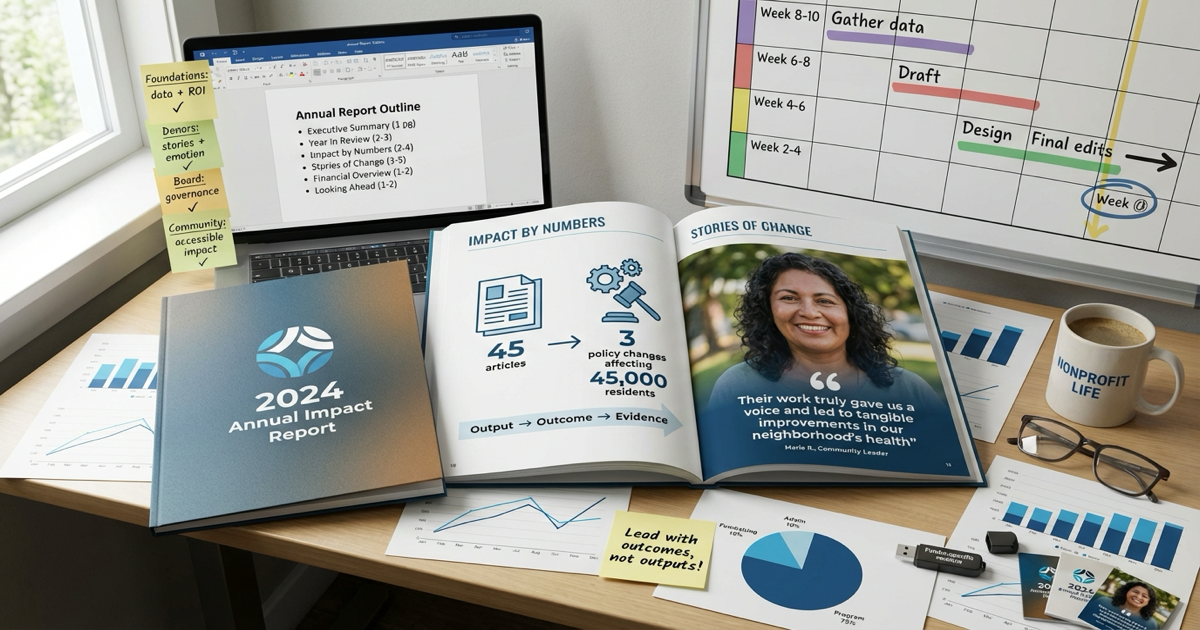
Annual Impact Report Template
A well-executed annual impact report is far more than a compliance document—it’s the most powerful tool for building trust with funders and securing future funding. This template provides a proven structure for creating compelling stakeholder reports that demonstrate your organization’s value while serving multiple audiences simultaneously.
Why Your Annual Report Matters
Your annual report is not just a retrospective summary. It’s a strategic fundraising asset that:
- Builds trust with existing funders by demonstrating stewardship
- Attracts new funders by showcasing your proven track record
- Renews relationships with individual donors and members
- Satisfies governance requirements for your board
- Engages your community by celebrating shared impact
When done right, your annual report becomes a persuasive case for increased support, not just a record of past activities.
The Multi-Purpose Challenge
One of the most difficult aspects of annual reporting is creating a document that serves diverse stakeholders:
- Grant-making foundations expect rigorous data, specific outcomes aligned with their mission, and measurable ROI
- Individual donors want inspiring stories, emotional connection, and proof their contribution matters
- Paying members seek transparency, accountability, and evidence of community value
- Board of directors need comprehensive financial oversight, strategic progress, and governance documentation
- Broader community looks for accessible impact, local relevance, and reason to care
The template below is designed to balance these competing needs, allowing you to create a core document that can be customized for specific audiences.
Report Structure: Section by Section
Executive Summary (1 page)
Your executive summary is the most critical section—many readers will read nothing else. Make it count.
What to include:
- Mission reminder: One sentence stating your organization’s core purpose
- Year’s highlight: The single most impressive outcome or achievement
- Impact snapshot: 3-5 key metrics that demonstrate reach and change
- Financial summary: Total budget, revenue sources breakdown, and key expenses
- Looking forward: One compelling priority for the coming year
Best practice: Write this section last, after you’ve completed the full report. It should distill your most powerful points into a compelling narrative that makes the reader want to learn more.
Year in Review (2-3 pages)
This section provides narrative context for your work throughout the year.
Structure:
- Major milestones: New programs launched, organizational growth, significant partnerships
- Challenges navigated: Demonstrate resilience and problem-solving (funders value organizations that can adapt)
- Strategic progress: How did you advance your long-term strategic plan?
- Team highlights: Key hires, leadership transitions, staff development
Avoid: A month-by-month recitation of activities. Focus on meaningful progress and transformation, not exhaustive chronology.
Impact by the Numbers (2-4 pages)
This is where you demonstrate measurable outcomes, not just outputs. Lead with the “so what” before the “what.”
Framework for journalism nonprofits:
| Output (Activity) | Outcome (Change) | Evidence |
|---|---|---|
| 45 articles published | 3 policies changed, 1 investigation launched | Legislative records, official statements |
| 2.3M page views | Community action: 500 residents attended town hall | Event records, community surveys |
| 15 media mentions | Shifted public discourse on key issue | Media analysis, official citations |
Key sections:
- Editorial impact: Stories published across coverage areas
- Real-world outcomes: Policy changes, investigations launched, community action catalyzed
- Reach and engagement: Audience growth, partnerships, distribution
- Thematic breakdown: Impact by focus area (accountability, education, environment, etc.)
Visualization tips:
- Use charts and infographics to make data scannable
- Include comparison to previous years to show growth
- Add geographic maps for local/regional context
Stories of Change (3-5 pages)
Numbers prove your impact; stories make it memorable and emotionally resonant.
Structure each story:
- The problem: What community challenge or information gap existed?
- Your work: What reporting or program did you create?
- The change: What specific, verifiable impact resulted?
- The voices: Quotes from community members, officials, or stakeholders
- The evidence: Links, citations, or documentation
Example structure:
Holding Officials Accountable on School Safety
After three years of inaction following parent complaints about deteriorating school facilities, our six-month investigation revealed $2.3 million in maintenance funds had been diverted to administrative costs. Within weeks of publication:
- The school board voted unanimously to restore full funding
- The superintendent resigned
- A new oversight committee was established
- 12 schools received emergency repairs
“Without this reporting, our children would still be in buildings with mold and broken HVAC systems,” said Maria Rodriguez, president of the Parent-Teacher Association.
Best practice: Include 3-4 detailed stories representing different impact types (policy change, community mobilization, individual life changed, investigation outcome).
Financial Overview (1-2 pages)
Transparency builds trust. Make your finances clear and accessible.
Essential elements:
- Revenue breakdown: Foundation grants (%), individual donors (%), earned revenue (%), other sources
- Expense allocation: Program services (%), fundraising (%), administration (%)
- Year-over-year comparison: Show growth and stability
- Financial health indicators: Months of operating reserve, debt levels
Key message: Frame your financial story around sustainability and stewardship. Show funders that their investment is part of a diversified, stable operation.
Common pitfall to avoid: Excessive administrative costs. If admin expenses exceed 15-20%, provide clear justification (one-time expenses, capacity building, infrastructure investment).
Looking Ahead (1-2 pages)
End with momentum and vision. This section is your case for continued support.
What to include:
- Strategic priorities: 2-3 major goals for the coming year
- Program expansion: New coverage areas, audience growth, partnerships
- Capacity building: Staff growth, technology investments, operational improvements
- Funding needs: Be specific about what support will enable
Tone: Balance ambition with realism. Show you have a plan, not just aspirations.
Call to action: Make it clear how readers can support this vision—renew their grant, increase their gift, become a member, or share your work.
Best Practices for Maximum Impact
1. Lead with Outcomes, Not Outputs
Don’t say: “We published 127 articles reaching 3.2 million people.”
Do say: “Our accountability reporting led to three policy changes affecting 45,000 residents, catalyzed a state investigation, and mobilized 500 community members to demand action.”
2. Use Specific Examples and Testimonials
Generic claims lack credibility. Specific details create trust.
Generic: “Our work made a difference.”
Specific: “After our investigation, State Senator Maria Garcia cited our reporting when introducing Bill S.2043, which passed unanimously.”
3. Visualize Data Effectively
- Use charts for trends over time
- Use infographics for complex processes
- Use maps for geographic impact
- Keep design clean and professional
4. Demonstrate ROI in Funder Language
Different funders care about different outcomes. When creating funder-specific versions:
- Knight Foundation: Emphasize innovation, reach, and information quality
- MacArthur Foundation: Focus on systemic change and public interest
- Community foundations: Highlight local impact and civic engagement
- Federal grants: Document compliance, milestones, and measurable objectives
5. Make It Accessible
- Write at an 8th-grade reading level for community versions
- Define jargon and acronyms
- Use active voice and clear language
- Break up text with subheadings, bullet points, and white space
Distribution Strategy
Your report should reach stakeholders through multiple channels:
- Digital PDF: Optimized for email and website download
- Web version: Make it easily shareable on social media
- Print copies: For board meetings, events, and major donors
- Funder-specific versions: Tailored language and emphasis
- Social media highlights: Create shareable graphics of key stats
- Email campaign: Segment your list and personalize the message
Timeline for Production
Start early to avoid last-minute scrambles:
- 8-10 weeks before: Gather data, request team input, draft narratives
- 6-8 weeks before: Complete first draft, internal review
- 4-6 weeks before: Design and layout, fact-checking
- 2-4 weeks before: Final edits, board approval, printing
- Release: Coordinate email, social media, and website launch
Transform Reporting from Burden to Engine
Creating a comprehensive annual report shouldn’t require weeks of scrambling through spreadsheets and email chains. When your impact data is centralized, continuously collected, and tagged to funder priorities throughout the year, generating a compelling report becomes a matter of hours, not weeks.
That’s the difference between reactive reporting and strategic impact management.