 Record Impact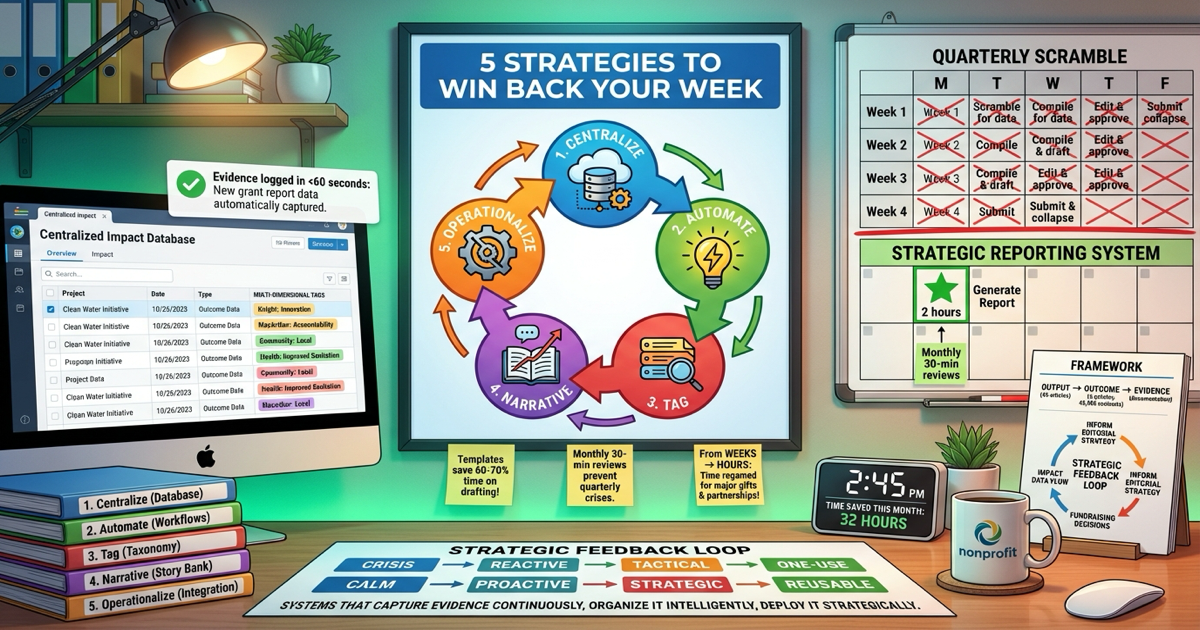
5 Ways to Streamline Your Grant Reporting and Win Back Your Week
Grant reporting doesn’t have to consume weeks of scrambling through spreadsheets and email chains. With the right systems and strategies, you can transform the process from a quarterly crisis into a smooth, predictable operation that takes hours instead of days—and positions your work more powerfully in the process.
These five strategies represent the fundamental shifts that separate organizations drowning in reporting from those who have mastered it as a strategic asset.
Strategy 1: Centralize Your Impact Universe
The Problem: Information Fragmentation
In most nonprofit newsrooms, critical impact information exists in “siloed systems”:
- Financial data lives in QuickBooks or another accounting system
- Programmatic outcomes are tracked in spreadsheets on individual laptops
- Powerful testimonials are buried in email threads
- Media mentions are noted sporadically in various documents
- Policy citations exist only in reporters’ memories
- Community feedback is scattered across Slack, email, and conversations
This fragmentation creates “poor records management” that makes compliance incredibly difficult. When a report is due, the Development Director must:
- Email program staff requesting data
- Wait for responses (often delayed)
- Manually combine information from multiple sources
- Cross-reference financial reports with programmatic outcomes
- Hunt through email for that perfect testimonial
- Reconstruct impact that occurred months ago from memory
This process is time-consuming, error-prone, and inevitably incomplete. Critical impact evidence gets lost because no one captured it or no one can find it.
The Solution: A Single Source of Truth
Establish a centralized, dynamic, and living repository for every piece of evidence related to your organization’s impact. This becomes the definitive hub for all grant-related information:
What to centralize:
- Stories published: Headline, date, author, coverage area, funder support
- Outcomes achieved: Policy changes, investigations launched, community mobilization, individual impact
- Financial data: Budgets, expenditures, grant allocations
- Media mentions: Where your work was cited, shared, or referenced
- Testimonials: Quotes from community members, officials, stakeholders
- Metrics: Audience data, engagement statistics, reach indicators
- Evidence: Documents, photos, videos, official citations
The transformation:
- From reactive to proactive: Instead of scrambling when a report is due, you have instant access to all relevant information
- From static to queryable: You can ask specific questions: “Show all climate reporting outcomes from Q2” or “List all Knight-funded impact”
- From buried to searchable: That powerful testimonial is findable in seconds, not lost in email
- From crisis to confidence: Unexpected opportunities (short-deadline RFPs, sudden funder meetings) become manageable
Implementation approach:
- Start simple: even a well-organized shared spreadsheet is better than fragmentation
- Progress to structured tools: Google Sheets works initially, but purpose-built journalism impact platforms like RecordImpact, or general databases like Airtable or Notion, provide better structure as you scale
- Match tool to need: journalism-specific tools understand the outcomes you’re tracking; general tools offer more flexibility but require more configuration
- Focus on consistency: the system only works if everyone uses it
Strategy 2: Automate Your Evidence Collection
The Problem: Manual Data Collection is Crushing
The manual collection of impact data is one of the most profound drains on Development Directors’ time. The pattern is familiar:
- Report deadline approaches
- Development Director sends requests to program staff
- Program staff (already overwhelmed) resent being pulled from core work
- Everyone scrambles to remember what happened months ago
- Data collection becomes a blame game (“This is your job!” “No, it’s yours!“)
- Information is incomplete because memories fade
- The Development Director becomes an administrator instead of strategist
This “data-chasing” administrative burden leaves no time for analysis, narrative development, or strategic fundraising.
The Solution: Capture Impact in Real-Time
Make impact collection an effortless, integrated part of daily workflow rather than a quarterly crisis. The goal: impact gets logged as it happens, when details are fresh and context is clear.
Method 1: Mobile-Friendly Quick-Capture Forms
Create simple forms that take less than 60 seconds to complete. Options include Google Forms, Typeform, Airtable forms, or purpose-built journalism impact tools like RecordImpact that have these capture workflows designed specifically for newsroom impact:
Example “Impact Noted” form:
- Story/project this relates to (dropdown)
- What happened? (brief description)
- Impact type (dropdown: policy, community, investigation, individual)
- Evidence (link, photo, or file upload)
- Submitted by (auto-captured)
- Date (auto-captured)
The key: Keep it to 3-5 fields maximum. If it takes longer than a minute, people won’t use it.
Inspired by the IA Impact Tracker, this approach has proven effective across nonprofit newsrooms.
Method 2: Dedicated Communication Channels
Create a Slack channel (#impact-evidence) or dedicated email address (impact@yournewsroom.org) where anyone can quickly share:
- Screenshots of social media reactions
- Forwarded emails from community members
- Links to other media citing your work
- Notes from conversations about impact
- Photos from community events
Example from practice: Charlottesville Tomorrow uses a Slack workflow to manage community input for their impact tracker, making evidence collection a natural part of team communication rather than a separate obligation.
Method 3: System Integrations
Automate what can be automated:
- Connect your CMS to your impact database to automatically log published stories
- Integrate Google Analytics to automatically capture audience data
- Set up alerts for media mentions of your organization
- Use Zapier or similar tools to connect your email/CRM to your evidence repository
The transformation:
- From quarterly crisis to daily habit: Impact capture becomes routine, not exceptional
- From incomplete to comprehensive: Nothing gets forgotten or lost
- From administrator to strategist: Development Directors focus on analysis and narrative, not data entry
- From friction to flow: Program staff spend seconds, not hours, on impact documentation
Critical success factor: Leadership must make impact capture a required part of the workflow, not optional. At Open Campus, impact briefs are compiled quarterly as a non-negotiable organizational practice, embedding impact tracking into the culture.
Strategy 3: Speak the Funder’s Language Through Strategic Tagging
The Problem: One Report Doesn’t Fit All Funders
Every foundation has distinct priorities. Knight cares about innovation and sustainability. MacArthur focuses on accountability and public interest. Your local community foundation wants neighborhood-specific impact. When you submit generic reports that don’t speak directly to each funder’s mission, you signal a lack of understanding or care.
The result: even excellent work appears misaligned with funder priorities.
The Solution: Multi-Dimensional Tagging
Build a robust tagging system where every piece of evidence in your centralized database is tagged with multiple, intersecting attributes:
Core tagging dimensions:
1. Funder & Grant
- Which specific grant(s) funded this work?
- Link every outcome to its funding source
- Enables precise ROI calculation per funder
2. Thematic Area
- Social Justice
- Public Health
- Education
- Government Accountability
- Environment/Climate
- Economic Development
- (Customize to your coverage areas)
3. Impact Type
- Policy Change (legislation, regulation, budget allocation)
- Investigation Launched (official inquiry, enforcement action)
- Community Mobilization (town halls, petition drives, organized response)
- Legal Outcome (lawsuit, settlement, court decision)
- Institutional Change (organizational policy, practice modification)
- Individual Benefit (person received services, avoided harm, etc.)
- Discourse Shift (sustained conversation, changed narrative)
4. Geographic Focus
- Specific neighborhoods, cities, counties, regions
- Critical for community foundations and local funders
5. Innovation Method (for innovation-focused funders)
- New technology used
- Novel distribution approach
- Experimental format
- Untested business model
The power of multi-dimensional tagging:
When Knight Foundation report is due, filter your database:
- Funder = Knight
- Thematic Area = any
- Impact Type = all types
- Innovation Method = highlight these
- Geographic Focus = all
Result: A report showing Knight-specific ROI with emphasis on innovation and experimentation.
When MacArthur report is due, filter:
- Funder = MacArthur
- Thematic Area = accountability-related themes
- Impact Type = Policy Change, Investigation Launched, Institutional Change
- Geographic Focus = relevant areas
- Innovation Method = de-emphasize
Result: A report focused exclusively on accountability journalism outcomes.
The transformation: Instead of writing one report and hoping it resonates, you generate reports that speak directly and exclusively to each funder’s priorities using their language and highlighting the outcomes they care most about.
Strategy 4: Weave a Data-Driven Narrative That Proves Real-World Change
The Problem: Numbers Without Stories, Stories Without Numbers
For too long, nonprofit newsrooms relied on output metrics: articles published, pageviews, social media followers. These metrics measure activity, not impact. Funders have decisively moved beyond outputs to outcomes—they want evidence of real-world change.
But pure numbers lack persuasive power. A table showing “3 policies changed” is informative but not memorable. Funders remember stories, not statistics.
The solution: blend both.
The Solution: Outcomes + Evidence + Narrative
Structure your reporting around the evolution from outputs to outcomes:
The Framework:
| What You Did (Output) | What Changed (Outcome) | How You Prove It (Evidence) |
|---|---|---|
| Published 45 articles on housing policy | City council created $5M affordable housing trust fund | Council meeting minutes, ordinance text, official vote record |
| Reached 2.3M readers | 500 residents attended city hall meeting demanding action | Event attendance records, community organization confirmation |
| Investigation into safety violations | State investigation launched, 12 schools received emergency repairs | Official investigation announcement, repair documentation |
The narrative structure:
Don’t write:
“We published 45 articles on housing policy reaching 2.3 million readers.”
Do write:
“Our six-month housing accountability investigation led to three concrete policy changes affecting 45,000 residents:
- The city council voted 8-1 to create a $5 million affordable housing trust fund
- The state housing authority launched an investigation into landlord practices we exposed
- Two major property management companies changed their eviction policies
The impact was catalyzed by 45 deeply reported articles published over six months, which collectively reached 2.3 million readers and were cited in official proceedings 23 times.
‘Without this reporting, vulnerable families would still be facing illegal evictions,’ said City Councilmember Maria Rodriguez, who sponsored the trust fund legislation.”
The formula:
- Lead with the outcome (policy change)
- Provide specific, verifiable details (dollar amount, vote count, specific actions)
- Show the scale of human impact (45,000 residents affected)
- Add the compelling human voice (councilmember testimonial)
- Then provide output context (45 articles, 2.3M reach, 23 citations)
The outputs now serve their proper purpose: supporting evidence that explains how the outcome was achieved. The outcome is the headline.
Making Impact Evidence Credible
Every outcome claim requires evidence that funders can verify:
Policy Change:
- Legislative bill number and text
- Council/committee meeting minutes
- Official vote records
- Budget allocation documents
Investigation Launched:
- Official agency announcements
- Inspector General reports
- Law enforcement press releases
- Court filings
Community Mobilization:
- Event photos and attendance records
- Petition signature counts
- Media coverage of community response
- Organizational statements
Individual Lives Changed:
- Testimonials (with permission)
- Documentation of outcome (anonymized if needed)
- Follow-up confirmation
The transformation: Reports move from merely informing to actively persuading. You’re not just documenting what happened—you’re making a compelling case for why this work matters and deserves continued support.
Strategy 5: Operationalize Your Reporting Cycle
The Problem: Reporting as Recurring Crisis
In too many organizations, grant reporting is not a process—it’s a series of recurring emergencies. Each deadline triggers scrambling, stress, and disruption. This reactive approach is unsustainable and prevents scaling.
The Solution: Transform Reporting into a System
Make reporting a smooth, predictable, continuous system that runs efficiently in the background of normal operations.
Component 1: Shared Grant Management Calendar
Create a centralized calendar visible to all relevant staff:
What to track:
- All grant report due dates
- Internal deadlines (2-3 weeks before external deadlines)
- Quarterly impact review meetings
- Mid-year funder check-ins
- Grant renewal windows
- Application deadlines for new opportunities
Tool options:
- Google Calendar with shared access
- Grant management software
- Project management tool (Asana, Monday, Trello)
The key: Make it the single source of truth. No one maintains separate deadline tracking.
Component 2: Clear Role Division
End the ambiguity about who does what:
Program Staff Responsibility:
- Capture impact evidence in real-time using simple forms (60 seconds)
- Attend monthly impact review meetings (30 minutes)
- Respond to specific questions during report drafting
- Provide context and interpretation of outcomes
Development Staff Responsibility:
- Set up and maintain easy capture systems
- Organize, analyze, and synthesize evidence
- Draft reports and narratives tailored to each funder
- Manage funder relationships and submission process
- Ensure compliance with all grant terms
The principle: Program staff capture raw evidence; development staff transform it into funder-appropriate narratives. Clear division eliminates conflict.
Component 3: Standardized Templates
Create internal templates for common report types:
- Quarterly foundation reports
- Annual impact summaries
- Project completion reports
- Federal grant compliance reports
Template elements:
- Standard section structure
- Required data points
- Word/character count guidelines
- Examples of strong vs. weak responses
- Checklist of required attachments
Templates save 60-70% of structural decision-making time, allowing focus on content quality.
Component 4: Regular Impact Reviews
Hold monthly 30-minute meetings (entire development + program leadership) to review:
- Impact evidence captured in the past month
- Upcoming reporting deadlines (next 60 days)
- Strong stories emerging for future reports
- Gaps in evidence collection that need addressing
- Learnings from recent reports
Example practice: Open Campus compiles quarterly impact briefs as standard organizational practice, making impact review continuous rather than deadline-driven.
The transformation:
- From crisis to calm: Reporting becomes low-stress and predictable
- From reactive to proactive: Always report-ready, never scrambling
- From tactical to strategic: Evidence informs editorial and fundraising strategy
- From one-use to reusable: Impact data gets captured once, used many times
The Strategic Feedback Loop
When reporting is operationalized as a system with regular review cycles, something profound happens: the impact data stops flowing only outward to funders and starts flowing inward to inform strategy.
The editorial team can analyze which types of reporting generate the most tangible impact and adjust coverage priorities.
The leadership team can see which funders’ interests align most closely with proven successes and tailor future proposals with confidence.
The development team can identify funding opportunities that match demonstrated organizational strengths.
The reporting system becomes a strategic asset that drives organizational learning and effectiveness, not just a compliance obligation.
Putting It All Together
These five strategies are interconnected and mutually reinforcing:
- Centralization creates the foundation for everything else
- Automation ensures the centralized system stays current without burden
- Tagging makes the centralized data useful for personalized reporting
- Narrative skill transforms data into persuasive cases for support
- Operationalization makes the entire system sustainable and stress-free
Organizations that implement all five don’t just save time—they fundamentally transform their relationship with funders from transactional compliance to strategic partnership.
The Bottom Line
Streamlined reporting isn’t about working harder or hiring more staff. It’s about building systems that capture evidence continuously, organize it intelligently, and deploy it strategically.
The hours you win back aren’t for taking a break—they’re for reinvesting in high-value activities: building relationships with new funders, diversifying revenue streams, and strengthening your organization’s long-term sustainability.
That’s the difference between surviving the reporting burden and transforming it into your most powerful fundraising engine.