 Record Impact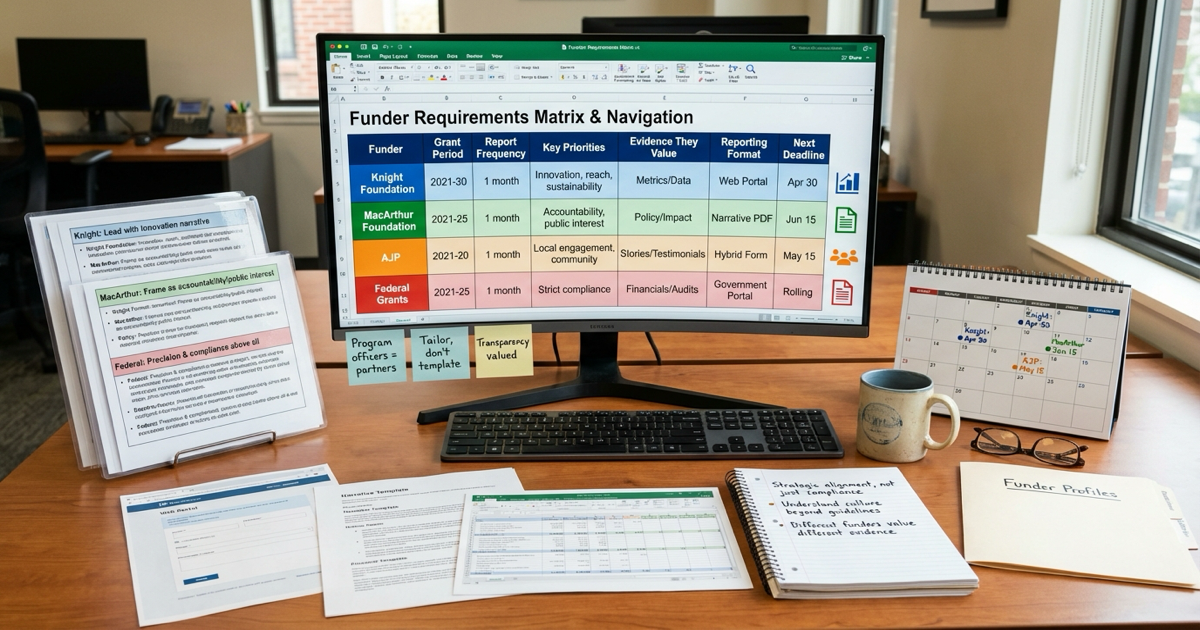
Navigating Major Funder Requirements
Successfully securing and maintaining foundation grants requires more than excellent journalism—it demands a sophisticated understanding of what different funders expect in their reports. Each major foundation has distinct priorities, reporting formats, and evidence requirements. Navigating these differences efficiently is a critical skill for nonprofit news leaders.
The Funder Paradox: Simplicity Meets Rigor
Foundations today find themselves caught in their own paradox. They’re acutely aware of the administrative burden their reporting requirements place on grantees. Many have publicly committed to simplifying their application processes, reducing paperwork, and streamlining compliance requirements to respect grantees’ limited capacity.
Yet these same foundations require rigorous proof of performance, detailed financial accountability, and tangible evidence of impact to justify their investments to their own boards and stakeholders. They need substantive, data-rich reporting that demonstrates return on philanthropic investment.
The result: Nonprofit journalism organizations find themselves caught between the promise of simplicity and the reality of substantive reporting demands. The application might be streamlined, but the reporting expectations remain comprehensive and time-intensive.
Understanding this tension is crucial. Foundations aren’t being hypocritical—they’re genuinely trying to balance competing pressures. The organizations that succeed are those who can efficiently provide the rigorous evidence funders need without allowing the process to consume their operational capacity.
Understanding Major Journalism Funders
Different funders have different cultures, priorities, and reporting philosophies. Tailoring your approach to each funder’s specific expectations dramatically increases your effectiveness and strengthens relationships.
Knight Foundation
Mission Focus: Knight Foundation supports journalism that informs and engages communities through innovation and sustainable business models.
What They Value:
- Innovation: Experimental approaches, new technologies, novel distribution methods
- Reach and impact: Audience metrics, community engagement, measurable influence
- Sustainability: Path to long-term financial viability, diversified revenue
- Information quality: Accuracy, depth, accountability journalism
Reporting Expectations:
- Quantitative metrics on audience reach, engagement, and growth
- Evidence of innovation and experimentation
- Clear documentation of how journalism informed or mobilized communities
- Progress toward sustainability goals and revenue diversification
- Specific examples of accountability journalism impact
Best Practices:
- Lead with innovation narrative—what did you try that was new or different?
- Emphasize community benefit and democratic outcomes
- Show clear metrics on reach while connecting to real-world impact
- Demonstrate progress toward financial sustainability milestones
- Be transparent about what worked and what didn’t—Knight values learning
MacArthur Foundation
Mission Focus: MacArthur’s Journalism & Media program supports independent journalism that holds power accountable and advances the public interest.
What They Value:
- Accountability journalism: Investigations, watchdog reporting, transparency
- Public interest: Journalism that serves democracy and informs civic participation
- Systemic impact: Policy changes, institutional reforms, sustained discourse shifts
- Underserved communities: Coverage of marginalized populations and issues
Reporting Expectations:
- Deep narrative on specific investigations and their outcomes
- Documentation of policy influence and governmental accountability
- Evidence of serving public interest and democratic function
- Clear articulation of how journalism addressed information gaps
- Long-term impact beyond immediate publication
Best Practices:
- Frame impact in terms of accountability and public interest, not audience metrics
- Provide detailed case studies of major investigations and their consequences
- Document influence on policy, legislation, or institutional practice
- Show how journalism empowered underserved communities
- Connect work to democratic values and civic health
American Journalism Project (AJP)
Mission Focus: AJP provides philanthropic capital and capacity support to local news organizations serving communities underrepresented in journalism.
What They Value:
- Local accountability: Filling critical local information needs
- Community engagement: Deep relationships with the communities served
- Organizational sustainability: Building durable business models
- Diverse leadership: Representative newsrooms and inclusive cultures
Reporting Expectations:
- Evidence of meeting local information needs
- Community engagement metrics and qualitative feedback
- Progress on sustainability and revenue targets
- Organizational development and capacity building
- Diversity, equity, and inclusion progress
Best Practices:
- Emphasize local accountability and community service
- Provide both quantitative metrics and rich qualitative community feedback
- Be transparent about financial health and sustainability challenges
- Demonstrate progress on DEI commitments
- Show how capacity building investments are paying off
Institute for Nonprofit News (INN)
Mission Focus: INN supports the nonprofit news ecosystem through advocacy, education, and capacity building.
What They Value:
- Journalistic excellence: Quality, ethics, impact
- Business sustainability: Diversified revenue, operational health
- Network collaboration: Sharing resources, cross-promotion, collective impact
- Innovation: New approaches to journalism, distribution, or business models
Reporting Expectations:
- Impact of INN resources and support on your organization
- Progress toward sustainability and revenue goals
- Participation in network activities and collaboration
- Examples of journalistic impact and community service
Best Practices:
- Quantify how INN support specifically helped your organization
- Share lessons learned that could benefit other network members
- Demonstrate active participation in the INN community
- Be candid about challenges and needs—INN is a support network
Federal Grants (NEA, NEH, CPB, etc.)
Mission Focus: Varies by agency, but all federal grants serve specific statutory mandates with strict compliance requirements.
What They Distinguish Themselves By: Federal grants are fundamentally different from foundation grants. They are binding legal agreements with:
- Strict terms and conditions codified in law and regulation
- Specific disbursement schedules tied to documented progress
- Detailed line-item budget accountability
- Rigorous compliance reporting on expenditures and outcomes
- Potential audit requirements
Reporting Expectations:
- Precise financial accounting mapped to approved budget categories
- Documented achievement of stated objectives and deliverables
- Compliance with all federal regulations and grant conditions
- Detailed narrative on activities completed during reporting period
- Supporting documentation for all claims
Best Practices:
- Maintain meticulous financial records from day one
- Document everything—federal grants may be audited years later
- Report exactly what you proposed to do; scope changes require prior approval
- Meet deadlines without exception—late reports can trigger funding holds
- Work closely with your grants administrator to ensure compliance
- When in doubt, ask your program officer before acting
Understanding Funder Cultures: Beyond the Guidelines
While written guidelines are important, understanding each funder’s culture and priorities gives you a significant advantage:
Foundation program officers are your partners, not adversaries. Most genuinely want you to succeed and will provide guidance if you ask. Building authentic relationships makes reporting easier and more effective.
Different foundations value different types of evidence. Some want quantitative data and metrics. Others prioritize qualitative narratives and community voices. Pay attention to what’s emphasized in their case studies and annual reports—that shows you what they value most.
Transparency about challenges is often valued. Many foundations prefer honest reporting about obstacles and lessons learned over relentlessly positive spin. They’re investing in organizations that can adapt and learn, not organizations that pretend everything is perfect.
Mission alignment matters more than perfect execution. If your work clearly advances a funder’s core mission, they’ll often be understanding about operational challenges or modified approaches. But if your impact isn’t aligning with their priorities, perfect reporting won’t save the relationship.
Best Practices by Funder Type
For National Foundations (Knight, MacArthur, etc.)
- Lead with big-picture impact and narrative
- Use data to support the story, not replace it
- Show alignment with their stated strategic priorities
- Demonstrate scalability or replicability of successful approaches
- Connect your local work to national implications
For Community Foundations
- Emphasize local impact and community benefit
- Include voices from community members served
- Show collaboration with other local organizations
- Demonstrate long-term commitment to the region
- Connect to local issues funders care about
For Individual Major Donors
- Personalize the narrative—they want to feel connected
- Show how their specific gift made a difference
- Include stories and testimonials, not just data
- Invite them into your newsroom (virtually or in person)
- Treat them like partners, not just ATMs
For Federal Grants
- Precision and compliance above all else
- Document every expenditure and deliverable
- Report on exactly what you proposed, in the same language
- Maintain audit-ready records at all times
- Never miss a deadline or reporting requirement
Creating a Funder Matrix
The most efficient approach to managing multiple funder relationships is to create a comprehensive funder matrix that tracks:
| Funder | Grant Period | Report Frequency | Key Priorities | Evidence They Value | Reporting Format | Next Deadline |
|---|---|---|---|---|---|---|
| Knight | 2024-2026 | Quarterly | Innovation, reach, sustainability | Metrics, case studies | Web portal | April 30 |
| MacArthur | 2024-2025 | Semi-annual | Accountability, public interest | Policy impact, investigations | PDF narrative | June 15 |
This matrix becomes your command center for grant reporting, ensuring nothing falls through the cracks and allowing you to see patterns across funders.
The Strategic Advantage of Understanding Requirements
Organizations that deeply understand funder requirements gain multiple advantages:
Efficiency: You can collect the right evidence from the start, rather than scrambling later Relationships: Tailored, thoughtful reporting strengthens funder partnerships Renewal rates: Meeting expectations consistently dramatically increases renewal likelihood Opportunism: Understanding what different funders value helps you identify which opportunities to pursue
The goal isn’t just compliance—it’s strategic alignment that serves both your mission and your funders’ goals.
When Requirements Conflict: Making Strategic Choices
Sometimes different funders’ requirements genuinely conflict. One wants extensive detail on audience metrics; another considers that focus a distraction from mission. One wants monthly check-ins; another prefers to be contacted only at formal reporting intervals.
When conflicts arise:
- Prioritize based on grant size and strategic importance
- Communicate proactively with program officers about constraints
- Seek permission to modify rather than failing to meet expectations
- Build systems that can flexibly serve different needs
Remember: most program officers have worked with hundreds of grantees. They understand operational realities. What they can’t tolerate is being surprised by problems you knew about months earlier.
The Path Forward
Navigating funder requirements doesn’t have to be overwhelming. With systematic tracking, clear understanding of priorities, and efficient systems for collecting and organizing evidence, you can meet diverse funder needs without consuming your development team’s capacity.
The organizations that master this balance don’t just survive the reporting process—they use it strategically to strengthen relationships, demonstrate value, and secure long-term support.