 Record Impact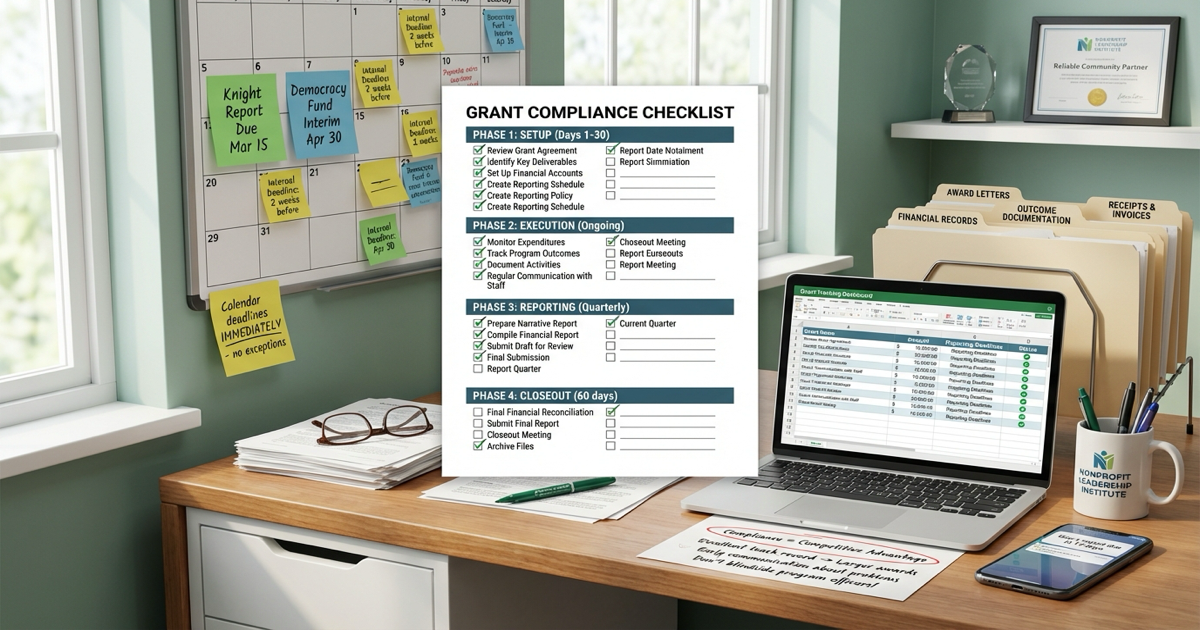
Grant Compliance Checklist
Grant compliance isn’t just about avoiding penalties—it’s about building the reputation and track record that unlocks future funding. In a competitive landscape where 86% of nonprofits pursue foundation grants but few receive impactful amounts, compliance becomes competitive advantage. This comprehensive checklist helps ensure you meet every critical requirement.
Understanding the Stakes
Non-compliance carries serious consequences that extend far beyond a single grant:
Immediate Financial Consequences
- Fund clawbacks: Funders can demand return of granted funds, creating sudden budget holes
- Payment holds: Future disbursements frozen until compliance issues resolved
- Reduced future awards: Even if renewed, grant amounts may be decreased
- Audit costs: Triggered compliance reviews consume staff time and may require external consultants
Long-Term Reputational Damage
- Weakened relationships: Trust with program officers damaged, sometimes irreparably
- Network effects: Foundation officers talk to each other; reputation spreads
- Board concerns: Non-compliance undermines confidence in leadership
- Reference problems: Future funders may contact current funders for references
Strategic Opportunity Cost
- Jeopardized renewals: Most foundation funding comes from existing relationships
- Eliminated consideration: Some foundations won’t consider organizations with compliance issues
- Restricted growth: Unable to pursue larger, multi-year, or unrestricted funding
- Competitive disadvantage: Other organizations with strong compliance records win contested opportunities
The message is clear: compliance isn’t an administrative burden to minimize—it’s a strategic asset to cultivate.
Understanding Grant Types: Different Rules, Different Stakes
Not all grants operate under the same compliance framework. Understanding the distinction between grant types is essential.
Foundation Grants
Foundation grants are contractual agreements between private organizations. While they have serious expectations, they also typically allow for:
- Reasonable flexibility on project implementation
- Conversation and negotiation about challenges
- Extensions or modifications when circumstances change
- Relationship-based problem-solving
Key compliance areas:
- Meeting reporting deadlines
- Using funds for stated purposes
- Achieving stated outcomes (or explaining why not)
- Maintaining communication with program officers
Federal Grants
Federal grants are binding legal agreements with the U.S. government. They operate under federal acquisition regulations and carry significantly stricter requirements:
- No flexibility without formal approval: Every scope change requires written modification
- Strict budget compliance: Cannot shift funds between categories without permission
- Detailed documentation required: All expenditures must be supported by receipts and justification
- Audit potential: Records may be examined years after grant completion
- Legal consequences: Serious violations can trigger investigation and legal action
Critical distinction: Federal grants operate under “must” language (legal requirements), while foundation grants typically operate under “should” language (expectations).
The Complete Grant Compliance Checklist
Phase 1: Grant Award and Setup (Days 1-30)
✓ Initial Documentation
- Save all award letters, agreements, and terms & conditions
- Create dedicated grant folder (digital and physical if required)
- Calendar all reporting deadlines immediately
- Calendar interim milestones (quarterly reviews, mid-year check-ins)
- Review budget line items and allowable expenses
✓ Financial Setup
- Create dedicated accounting code or fund for grant
- Set up separate tracking for this grant in accounting system
- Brief accounting/finance team on restrictions and requirements
- Establish process for time allocation if staff costs are covered
- Set up invoice/receipt filing system
✓ Team Alignment
- Brief all team members working on grant-funded activities
- Assign clear ownership: who captures outcomes? who compiles reports?
- Establish internal deadline (2 weeks before funder deadline minimum)
- Create shared calendar for grant milestones
- Set up regular check-in meetings (monthly minimum)
✓ Relationship Management
- Schedule introductory call with program officer if you haven’t met
- Ask about reporting preferences (what do they most want to see?)
- Clarify any ambiguities in grant terms before starting work
- Save all contact information for grant management team
- Understand escalation path if problems arise
Phase 2: Grant Execution (Ongoing)
✓ Financial Tracking (Weekly)
- Code all grant-related expenses correctly
- Save receipts and supporting documentation
- Track spending against budget categories
- Monitor burn rate to ensure appropriate pacing
- Flag potential overages or underspending immediately
- Document any in-kind contributions or matching funds
- Track staff time if labor costs are included
✓ Outcome Documentation (Continuous)
- Capture impact evidence in real-time, not at deadline
- Collect community testimonials and stakeholder quotes
- Document policy citations, media mentions, official responses
- Take photos/video of events, community engagement
- Save all relevant coverage or publications
- Track metrics specified in grant agreement
- Note unexpected outcomes (positive or negative)
✓ Deadline Management (Monthly)
- Review all upcoming deadlines at monthly team meeting
- Assign specific owners for each deliverable
- Build buffer time (never plan to submit on due date)
- Track deliverable status (not started / in progress / complete)
- Escalate potential delays immediately
- Document reasons for any delays or challenges
✓ Scope and Budget Management
- Monitor progress against stated objectives
- Document any necessary pivots or adjustments
- Seek formal approval before making significant changes
- Keep program officer informed of major developments
- Don’t assume flexibility—always ask before deviating
- Document decision rationale for significant choices
Phase 3: Reporting Periods (Quarterly/Semi-Annual/Annual)
✓ Pre-Reporting (2-4 weeks before deadline)
- Request financial reports from accounting department
- Gather all outcome data and evidence
- Interview program staff about impact and learnings
- Compile metrics required by grant agreement
- Draft narrative sections
- Identify any compliance issues to address
✓ Report Compilation (1-2 weeks before deadline)
- Follow required format exactly (don’t freelance)
- Include all required sections and attachments
- Provide specific examples and evidence
- Be honest about challenges and adaptations
- Proofread thoroughly (errors signal carelessness)
- Have second person review before submission
- Prepare supporting documentation
✓ Report Submission (3-5 days before deadline)
- Submit through required channel (portal, email, mail)
- Confirm receipt of submission
- Save confirmation email or receipt number
- File copy of submitted report
- Brief team on what was reported
- Schedule follow-up with program officer if needed
✓ Post-Submission
- Respond promptly to any follow-up questions
- Address any flagged issues immediately
- Document all post-submission communications
- Update internal records with submission confirmation
- Conduct brief retrospective: what went well? what to improve?
Phase 4: Grant Closeout (Final 60 Days)
✓ Final Financial Accounting
- Compile complete financial report for entire grant period
- Ensure all expenses properly documented and allocated
- Return any unused funds if required
- Submit final financial report
- Request final disbursement if payment schedule requires
- Archive all financial records per retention requirements
✓ Final Impact Reporting
- Compile comprehensive outcome data for entire grant period
- Provide final metrics and evidence
- Include long-term impact where measurable
- Share learnings and recommendations
- Submit final narrative report
- Provide any required data or artifacts
✓ Relationship Maintenance
- Thank program officer and grant team
- Request feedback on your reports and partnership
- Ask about renewal possibilities and timeline
- Understand any changes to future application process
- Maintain connection even if not seeking renewal
- Update CRM/database with final grant information
✓ Internal Closeout
- Document lessons learned for future grants
- Update internal templates based on experience
- Thank team members who contributed
- Archive all grant materials per policy
- Close out accounting codes
- Update grant tracking systems
Specific Compliance Requirements by Grant Type
Foundation Grant Essentials
Financial Compliance:
- Use funds only for stated purposes in proposal
- Generally flexible budget categories with notification
- Maintain basic receipts and financial records
- Provide summary financial reporting (not detailed line-item)
Narrative Compliance:
- Demonstrate progress toward stated objectives
- Explain obstacles and adaptations
- Provide evidence of impact and outcomes
- Maintain regular communication
Relationship Compliance:
- Meet reporting deadlines or request extensions in advance
- Respond to program officer communications promptly
- Provide credit/attribution in publications
- Invite funders to relevant events or activities
Federal Grant Essentials
Financial Compliance:
- Maintain detailed, auditable financial records
- Follow approved budget exactly or request formal modifications
- Document all time allocation with time sheets
- Comply with federal procurement rules for purchases
- Maintain records for required retention period (often 3-7 years)
- Prepare for potential audit at any time
Programmatic Compliance:
- Deliver exactly what was proposed
- Meet all stated objectives and deliverables
- Request formal approval for any scope changes
- Maintain detailed records of all activities
- Comply with all federal regulations (civil rights, accessibility, etc.)
Reporting Compliance:
- Submit all required reports on time without exception
- Use required formats and systems
- Provide all requested documentation
- Respond to government inquiries promptly
- Maintain strict accuracy in all statements
Red Flags That Trigger Problems
Immediate Action Required If:
- You realize you spent grant funds on ineligible expenses
- You will miss a reporting deadline
- You cannot achieve a stated objective
- Project scope needs to change significantly
- Key personnel named in grant leave organization
- Budget category will be significantly over or under
- You discover error in previous report
Response Protocol:
- Don’t hide it—problems get worse, not better
- Notify program officer immediately
- Explain the situation clearly and completely
- Propose a solution or request guidance
- Document the conversation and agreed resolution
- Follow up in writing
- Implement solution and report back
Program officers deal with problems constantly. What they can’t tolerate is being blindsided. Early, honest communication about challenges is always the right approach.
Compliance as Competitive Advantage
Organizations with excellent compliance records:
- Win contested grant competitions
- Receive larger, multi-year awards
- Get approached for new opportunities
- Build reputations as reliable partners
- Spend less time on each subsequent report (systems built)
Compliance isn’t about checking boxes—it’s about building the organizational discipline that enables sustainable growth.
Tools and Systems That Help
Grant Management Software:
- Centralized deadline tracking
- Document storage and version control
- Automated reminders and workflows
- Budget vs. actual tracking
- Reporting template libraries
Basic Systems (If Software Isn’t an Option):
- Shared grant calendar (Google Calendar, Outlook)
- Dedicated grant folders (Google Drive, Dropbox)
- Grant tracking spreadsheet
- Standard reporting templates
- Regular team check-in meetings
The sophistication of your tools matters less than the consistency of your systems. Start simple and improve over time.
The Bottom Line
Grant compliance is non-negotiable and non-optional. But when approached systematically, it transforms from overwhelming burden to manageable process that becomes easier with every grant cycle.
The organizations that master compliance don’t just avoid problems—they build reputations as exceptional partners that funders want to support with larger, longer, and more flexible grants.